
How to Use a Vision Board to Manifest
Your board is already made. Here are six ways to use it each day, so it becomes part of your practice rather than part of the wall.
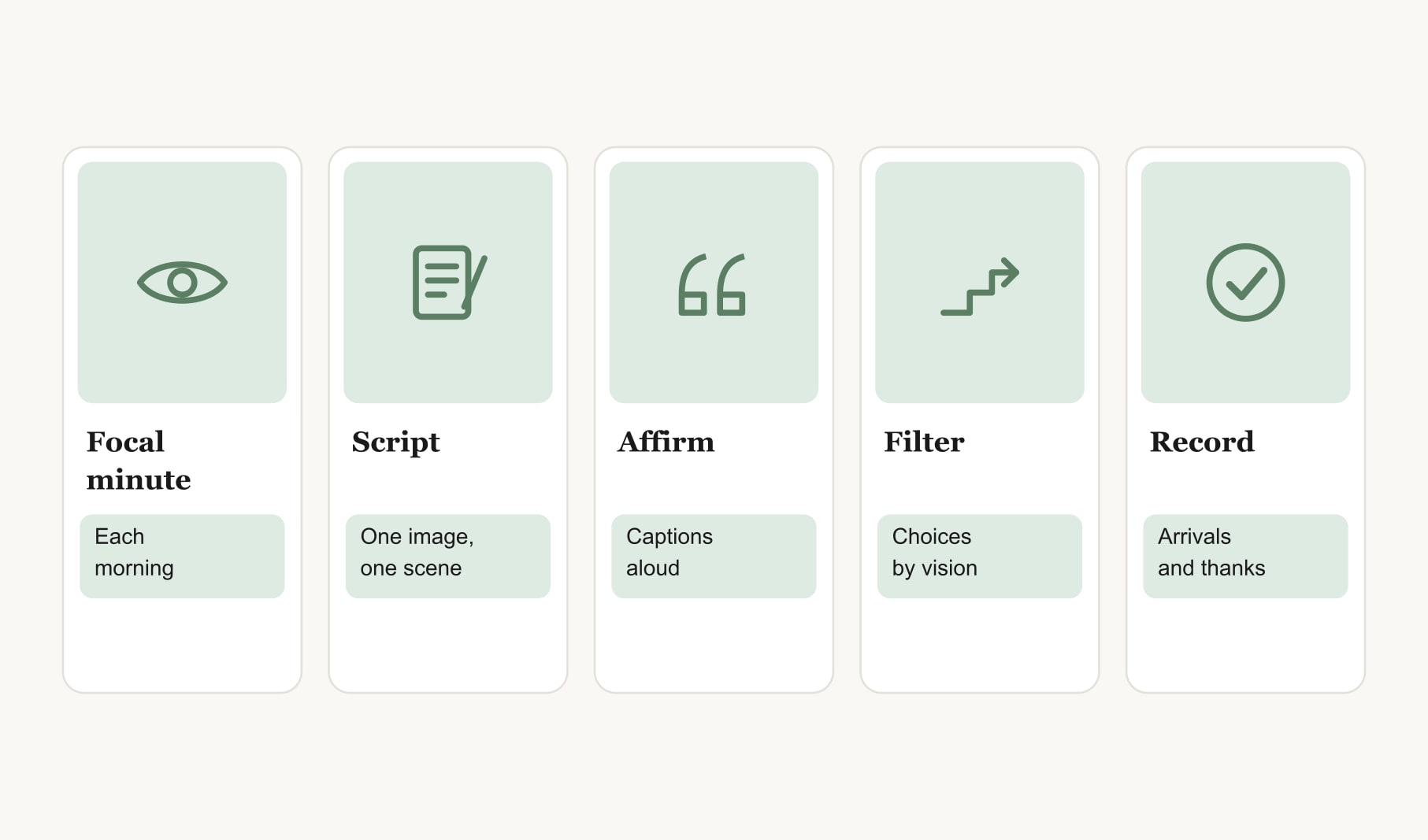
To use a vision board to manifest, make it active in your day. Sit with it for one focused minute each morning, script a scene from one image, turn captions into affirmations, use it to filter decisions, record what arrives with gratitude, and refresh it whenever your intentions shift.

Making a board is the easy part. Learning how to use a vision board to manifest, day after day, is where most of the practice actually lives. A board that hangs on the wall and is never used is a lovely decoration and little more. So this guide assumes your board is already made, and shows you six ways to bring it into your daily life.
These uses fit many beliefs. Whether you think of manifesting as prayer, intention, the law of attraction or simple focus, each one adapts to your own language. If you are still choosing how to begin, my season-long guide to manifesting using a vision board sets out the bigger structure, and this guide fills in the daily tools.
How to use a vision board to manifest, one use at a time
Step 1: Use it as a one minute focal point
Each morning, give the board one minute of your full attention. Sit or stand where you can see it clearly. Breathe slowly three times. Then choose one vision, just one, and let yourself feel it as present: the light in that kitchen, the sound of that sea, the ease of that morning. That minute gives your practice a definite beginning, and a definite beginning is what most practices lack.
Rotate the vision you choose each day, so every part of the board gets attention across a week.
Step 2: Script a scene from one image
Scripting means writing about a vision as if it has already happened. Choose one image and write a short scene in the present tense, five or six sentences: where you are, what you see, who is with you, how it feels. “I unlock the door of my bright little flat. Sunlight lies across the floor. I put the kettle on and sit by the window.” A scripting journal template gives you prompts if a blank page feels daunting.
Once or twice a week is plenty. Scripting works best as a deep dive, not a daily chore.
Step 3: Turn captions into affirmations
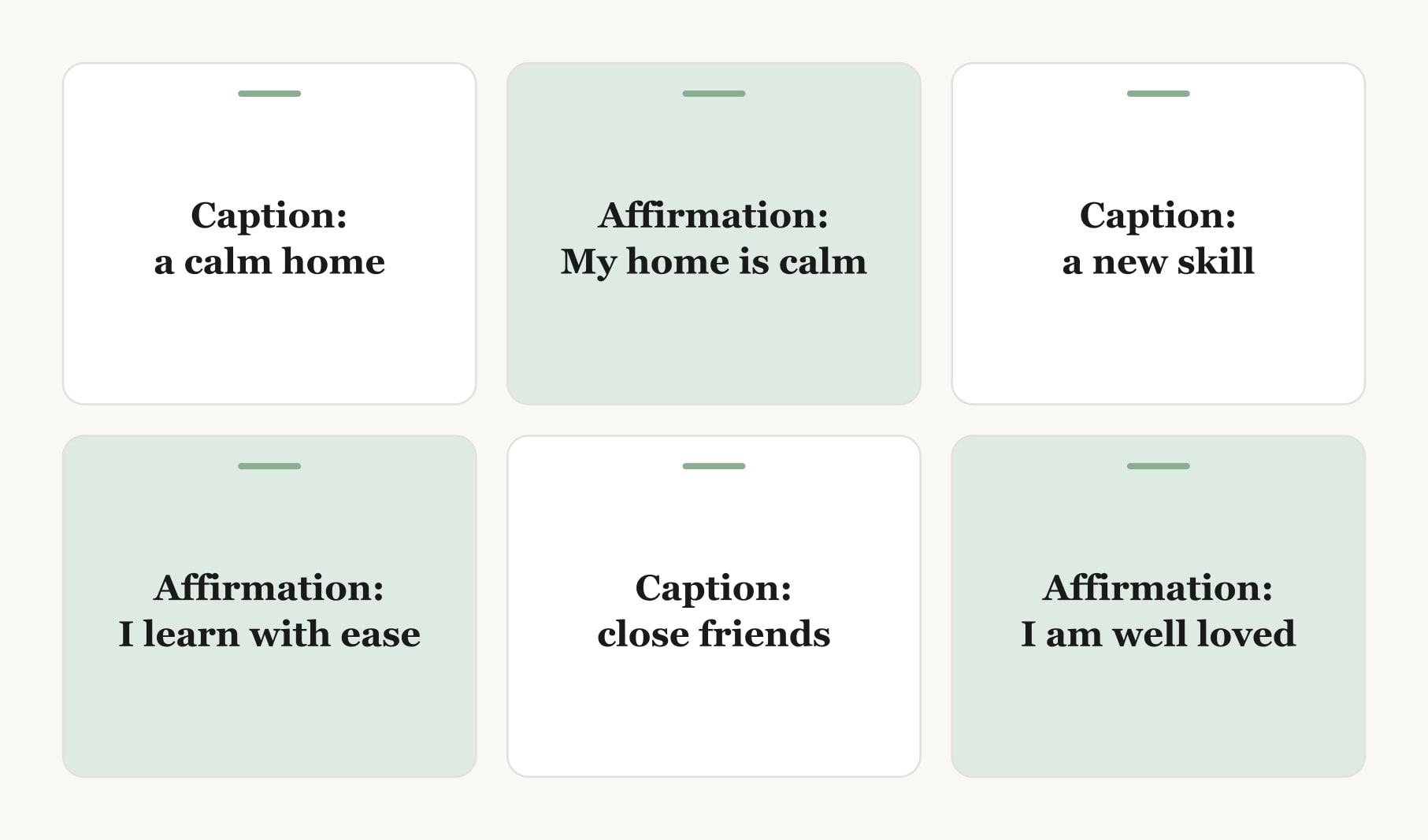
Every caption on your board can become an affirmation. “A calm home” becomes “My home is calm.” “A new skill” becomes “I learn with ease.” Write each one on a card or in your phone, and say one aloud each day, ideally after your focal minute. If you want more variety, use an affirmation generator for your vision board and keep only the lines that sound like you. An affirmation you would never say in your own voice will not land.
Step 4: Use it as a decision filter
This is the most practical use, and the one people overlook. When a choice comes up, large or small, glance at the board and ask: which option moves me toward these visions? Should I say yes to that extra project? Should I spend this evening scrolling or reading for the course? The board will not decide for you, but it reminds you what you said mattered, at the very moment it counts.
Many people describe this as acting in alignment. Whatever you call it, it is where intention turns into a life that looks different.
Step 5: Keep a record of arrivals and small signs
Write down what arrives. Not only the big things, but the small openings: a conversation that pointed somewhere useful, an unexpected invitation, a step that suddenly felt easy. Note the aligned actions you took too, and give thanks for each entry. A manifestation tracker keeps these notes in one place, so you can look back after a month and see the pattern rather than rely on memory.
Step 6: Refresh it when your intentions shift
Your board should change as you do. When a vision arrives, celebrate it and take it down, or move it to a corner of completed visions. When a vision no longer feels true, release it without guilt. Then add new visions that match where your heart is now. A board that reflects your present intentions will always serve your practice better than one that reflects who you were last year.
Which uses should you start with?
Start with two: the focal minute and the decision filter. They take almost no time, and together they cover both sides of the practice, the inner work of feeling and the outer work of choosing. Once they feel natural, after two or three weeks, add affirmations. Add scripting and the record when you want to go deeper. Trying all six on day one usually means keeping none of them by day ten.
Can you use a digital board the same way?
Yes, and some uses get easier. A board on your phone is always with you for the decision filter, and you can read its captions as affirmations anywhere. You can build a manifestation vision board online and set it as your lock screen, so your focal minute can happen on a bus as easily as at home.
What should you avoid when you manifest with a board?
Avoid using the board as a demand. Using it to manifest is a practice of focus, feeling and aligned action, and no practice can promise a particular outcome on a particular day. Avoid comparing your board with anyone else’s progress, too. Your visions are yours, and so is your timing. Hold them with an open hand, keep taking small steps and let gratitude carry you through the quiet weeks.
Keep reading
How to use a vision board to manifest: your questions
Give your vision board one focused minute each morning, choosing one vision and feeling it as present. Then use the board as a decision filter during the day, asking which choice moves you toward your visions. Add affirmations, scripting and a gratitude record as these two habits settle.
Scripting means writing a short scene about one vision in the present tense, as if it has already happened. Choose an image from your vision board, describe where you are, what you see and how it feels, and keep it to five or six sentences once or twice a week.
Rewrite each vision board caption as a short present-tense sentence in your own voice. A calm home becomes my home is calm, and a new skill becomes I learn with ease. Say one aloud each day, ideally right after your morning minute with the board.
When a choice comes up, look at your vision board and ask which option moves you toward your visions. The board will not decide for you, but it reminds you what you said mattered at the very moment it counts, which many people describe as acting in alignment.
Change your manifestation vision board whenever your intentions shift. Celebrate and remove visions that arrive, release ones that no longer feel true without guilt, and add new visions that match where you are now. Many people also refresh the whole board at the turn of each season.
Yes. A vision board on your phone is always with you, which makes it easy to use as a decision filter and to read its captions as affirmations anywhere. Set it as your lock screen so your morning minute can happen wherever your day begins.
Beginners do best starting with two vision board habits: a one minute morning focus and using the board as a decision filter. Both take little time and cover feeling and action. Add affirmations after a few weeks, then scripting and a gratitude record when you want to go deeper.
Keep your vision board alive
A board built in your browser resets when you close the tab. Vision Boardly saves your boards, reminds you as each vision date arrives, and tracks the habits and moods moving you toward them.
Get Vision Boardly Free