Goals to Put on Vision Board
Most boards hold one kind of goal: achieve something big. Here are eight kinds, and why a mix makes a board you keep using.
Good goals to put on vision board squares come in eight kinds: start goals, swap goals, keep goals, finish goals, learn goals, experience goals, give goals and rest goals. Pick three to five from different kinds, write each as a short caption with a season and a first step, and pair it with one clear image.
Most of the goals to put on vision board squares that I see are the same kind: achieve something big. A promotion, a marathon, a home. Those goals are great, but a board made only of them feels like a list of exams. Over the years I have found eight kinds of goal, and a board that mixes three or four kinds is the one people keep looking at.
Which goals to put on vision board squares work best?
The ones that are specific, that you genuinely want and that you can start this week. Within that, variety helps. A finish goal gives you a deadline, a keep goal protects something good, a rest goal stops the board from turning into pressure. Read the eight kinds below and notice which ones your current board is missing.
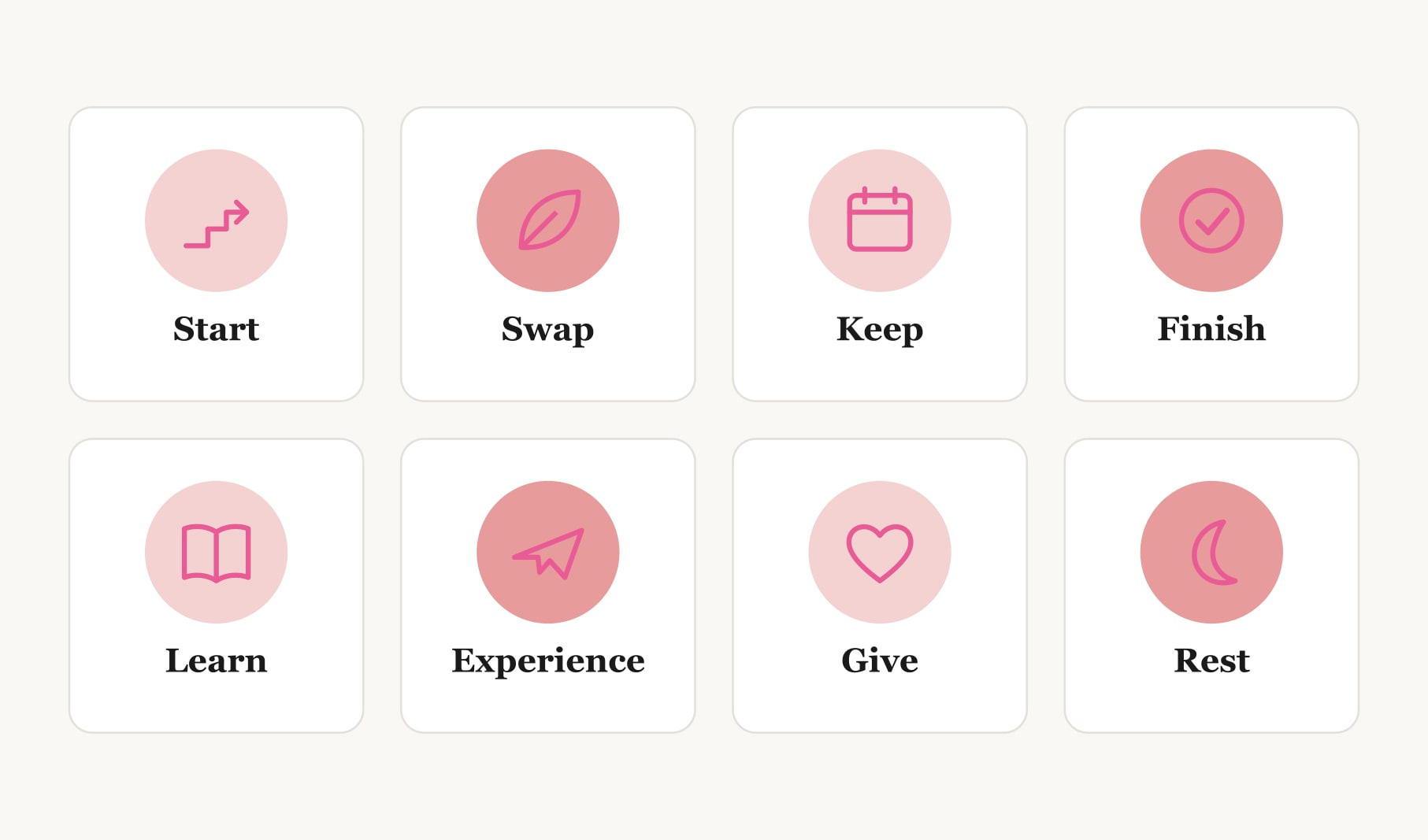
What are start goals and swap goals?
Start goals begin something new: start a weekly pottery class, start a savings jar for a trip, start a garden in pots. They suit anyone who feels stuck, because the first session is the whole goal.
Swap goals replace one habit with another. Instead of “stop scrolling at night”, try “read ten pages before sleep”. Swapping is kinder than stopping, and it gives you an image to put on the board: a book on a pillow rather than a phone crossed out. Track the new habit in a habit tracker for your vision board so you can see the swap taking hold.
What are keep goals and finish goals?
Keep goals protect something you already have. Keep walking with a friend on Saturdays. Keep the allotment going. Keep calling a grandparent each week. These are the most overlooked goals of all, and losing them hurts more than missing a new one.
Finish goals close something open: finish the shelf, finish the course, finish the photo album. They give a board momentum, because crossing one off feels wonderful. If you have several half-done projects, choose one finish goal per season.
What are learn goals and experience goals?
Learn goals build a skill: hold a short conversation in Portuguese, bake a loaf you are proud of, play three songs on the guitar. Give each a small, testable finish so you know when you have arrived.
Experience goals are moments rather than results: see the northern lights, swim in a lake, eat at a long table in a new city. They are what you will tell stories about, and they belong on every board.
What are give goals and rest goals?
Give goals point outward: volunteer once a month, cook for a neighbour, mentor someone starting out, give time to a cause you care about. They balance a board that might otherwise be all about you, and they often bring the deepest satisfaction.
Rest goals protect your energy: one evening a week without screens, a real lunch break, a slow morning each weekend, a week away with no plans. A rest goal on the board gives you permission to slow down. If rest is what you need most, a self-care vision board keeps it front and centre.
How do you word a goal so it fits on a board?
Use a short caption formula: a verb, a detail, a first step and a season. “Finish the shelf, by autumn, first step: buy brackets.” “Swim in a lake, this summer, first step: find a swim spot.” Start with a verb so the caption reads as an action. Keep it under ten words, so it fits under an image without crowding it.
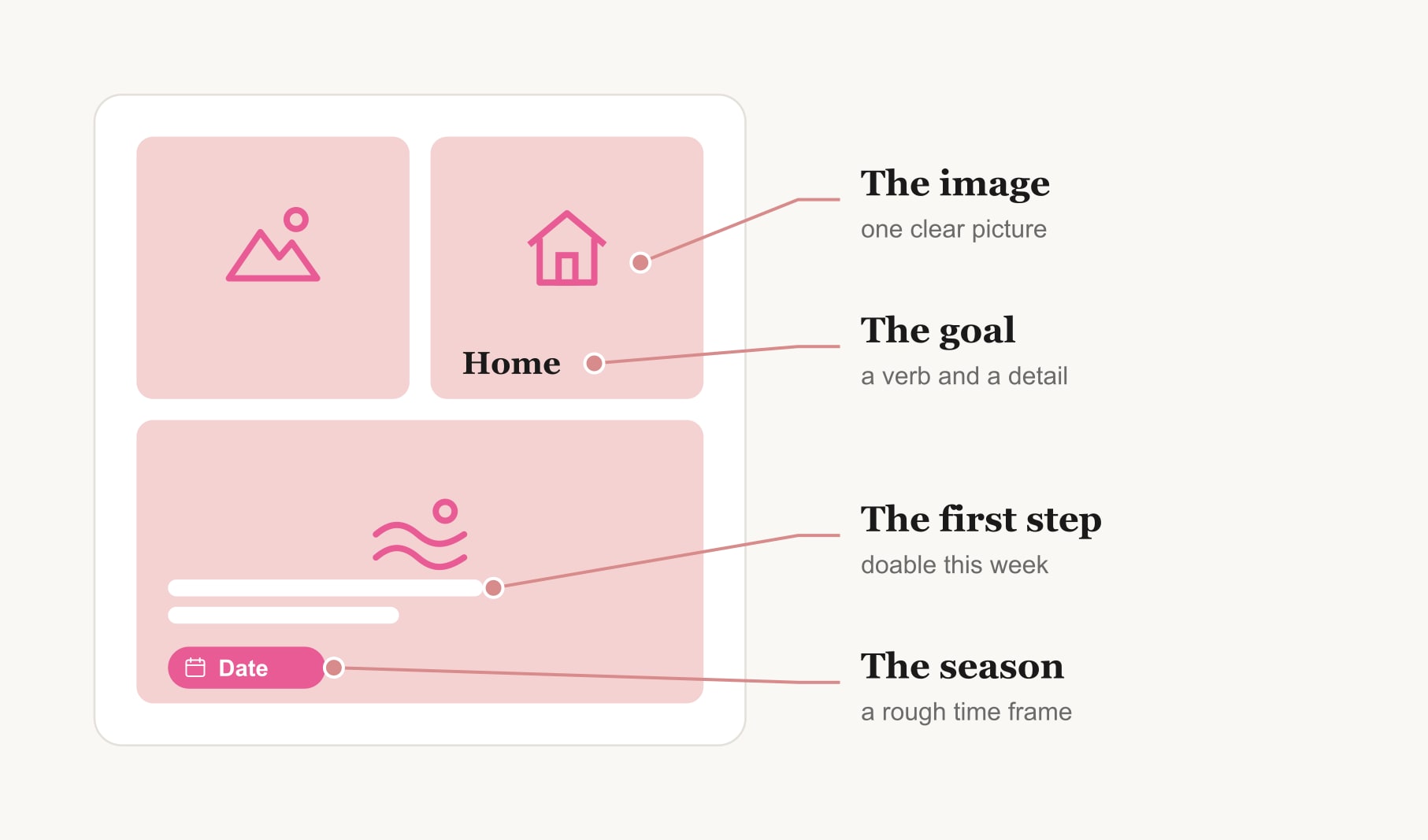
If a goal needs a long sentence to explain, it is probably two goals. Split it, and pick the half that matters more this season.
How do you know which kind of goal you need most?
Look at how you feel when you think about the next few months. Restless usually means you need a start or experience goal. Scattered means you need a finish goal, because open loops drain energy. Tired means a rest goal comes first, before anything else. Lonely points to a give goal or a keep goal with people at its heart. Let that feeling choose your first square, then fill the rest with variety.
What if two goals pull against each other?
It happens often: a learn goal that needs evenings and a rest goal that protects them. You do not have to choose one forever. Give them different seasons, or give each a fixed slot, such as class on Tuesdays and a slow Sunday every week. Writing the slot into each caption shows you the plan holds both.
How many goals should go on one board?
Three to five is the sweet spot, and nine is a sensible ceiling. Pick from at least three different kinds. A good starting mix is one start or learn goal, one finish goal, one experience goal and one rest or give goal. For goals that need structure, the SMART goals vision board helps you shape each one before it goes up.
What does a board of mixed goals look like?
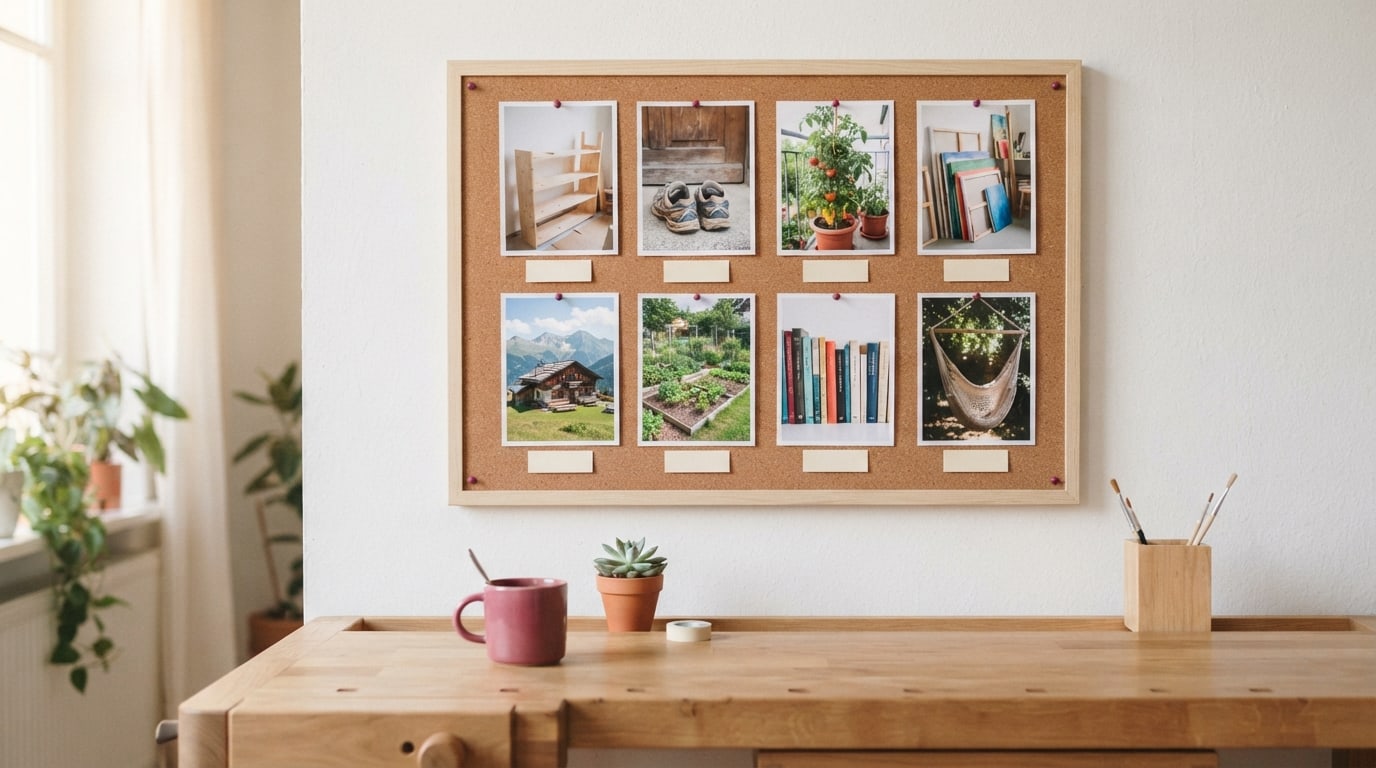
This is a mix I would put on my own wall. Top row: a half-built shelf for “finish the shelf, by autumn”, running shoes for “keep Saturday runs” and a tomato plant for “start a balcony garden, this spring”. Bottom row: a mountain hut for “a hiking weekend with friends”, a community garden for “volunteer once a month” and a hammock for “one slow Sunday a month”. Six goals, six kinds, and not one of them feels like an exam.
When you want a ready set of squares for a goal-led board, the goal setting vision board lays them out for you.
Keep reading
Goals to put on vision board: your questions
Put three to five specific goals on your vision board, drawn from different kinds: a start or learn goal, a finish goal, an experience goal and a rest or give goal. Choose goals you genuinely want and can start this week, then pair each with one clear image.
A keep goal on a vision board protects something good you already have, such as a weekly walk with a friend, a garden or a regular call with family. Keep goals are often overlooked, yet they guard the parts of life that matter most when things get busy.
A swap goal on a vision board replaces one habit with another, such as reading ten pages instead of scrolling before sleep. Swapping is kinder than stopping, and it gives you a positive image for the board instead of a picture of something you want less of.
Write a vision board caption as a verb, a detail, a first step and a season, such as finish the shelf, by autumn, first step: buy brackets. Keep it under ten words, so it fits beneath the image and reads at a glance from across the room.
Yes, a rest goal belongs on most vision boards. One evening a week without screens or a slow weekend morning gives you permission to slow down and stops the board from feeling like pressure. Rest goals also protect the energy you need for every other goal.
More than nine goals is usually too many for one vision board. Beyond that point, goals compete for attention and none gets a real first step. If your list is longer, keep the rest on a separate page and rotate them in as goals on the board are finished.
Keep your vision board alive
A board built in your browser resets when you close the tab. Vision Boardly saves your boards, reminds you as each vision date arrives, and tracks the habits and moods moving you toward them.
Get Vision Boardly Free