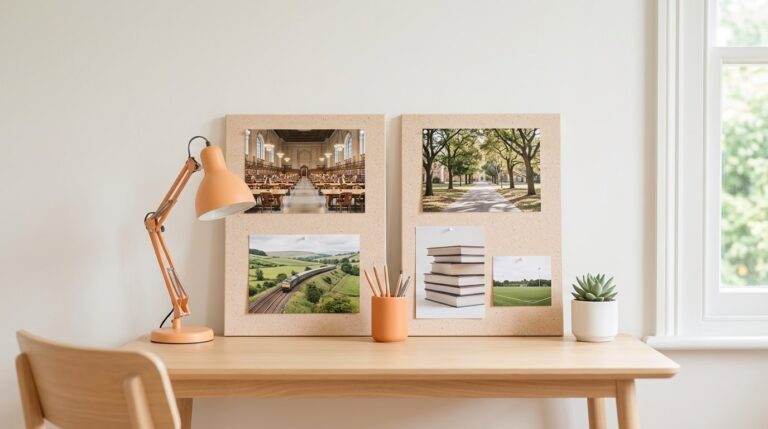
Making a Vision Board for a Goal
Making a Vision Board for a Goal
A whole board for one goal, laid out as a path from here to done, with a picture for every milestone along the way.
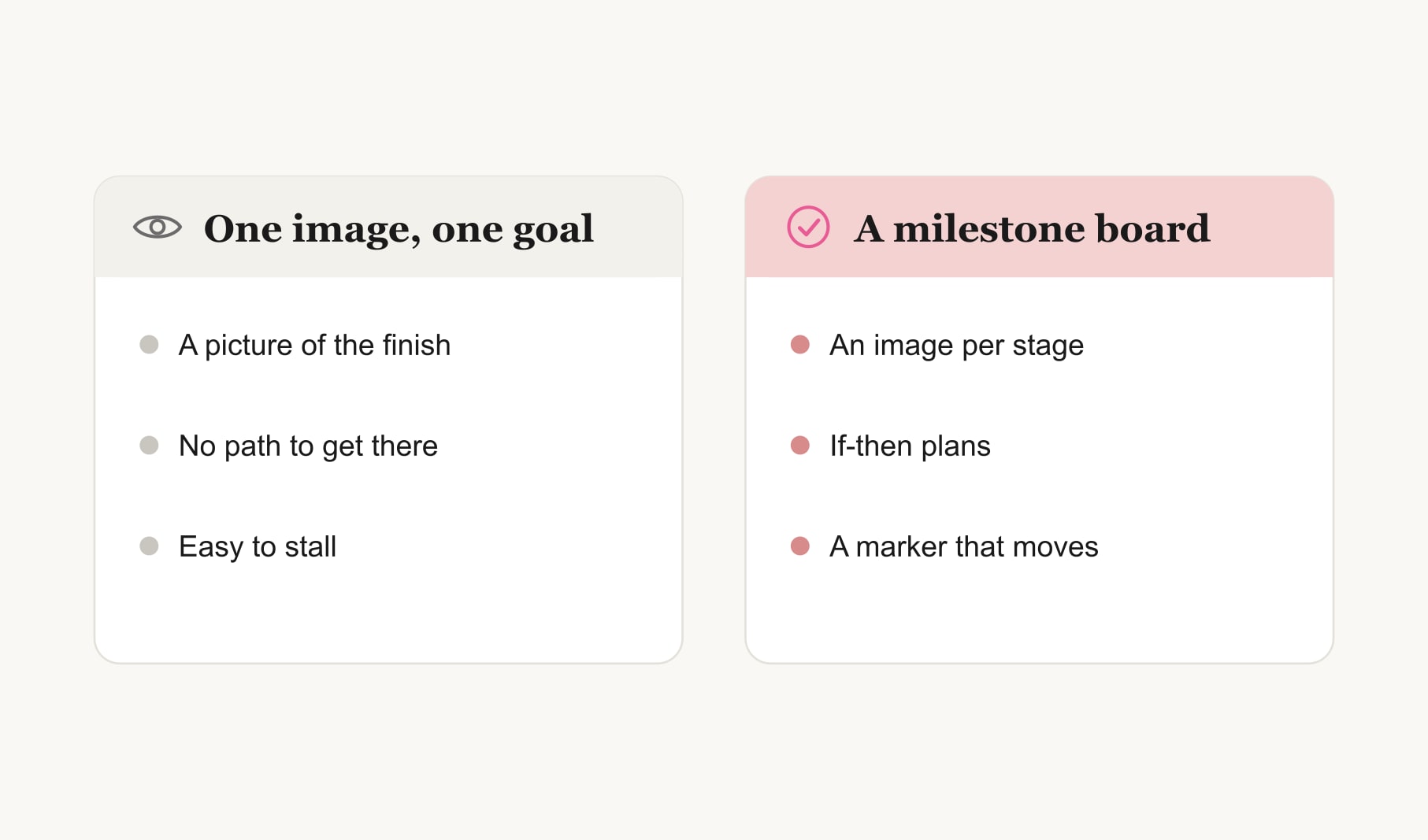
Making a vision board for a goal starts with the goal in one specific sentence. Break it into four to six milestones with months, choose an image for the finish and one for each milestone, arrange them as a path, add an if-then plan for likely obstacles, write this week’s first step and move a marker as you progress.

Sometimes one goal deserves a whole board. A marathon, a degree, a move, a business, a big creative project. Making a vision board for a goal like that is different from a general board: instead of many dreams, you lay out one path, from here to done, with a picture for every milestone. Here is how, in eight steps.
Step 1: How do you write the goal?
In one specific sentence, with what done looks like and a target month: “Run a half marathon in October.” “Finish my certificate by June.” “Move to the coast by next summer.” A clear sentence makes every later step easier. My guide to vision board goals has more on writing goals that work.
Step 2: Making a vision board for a goal starts with milestones
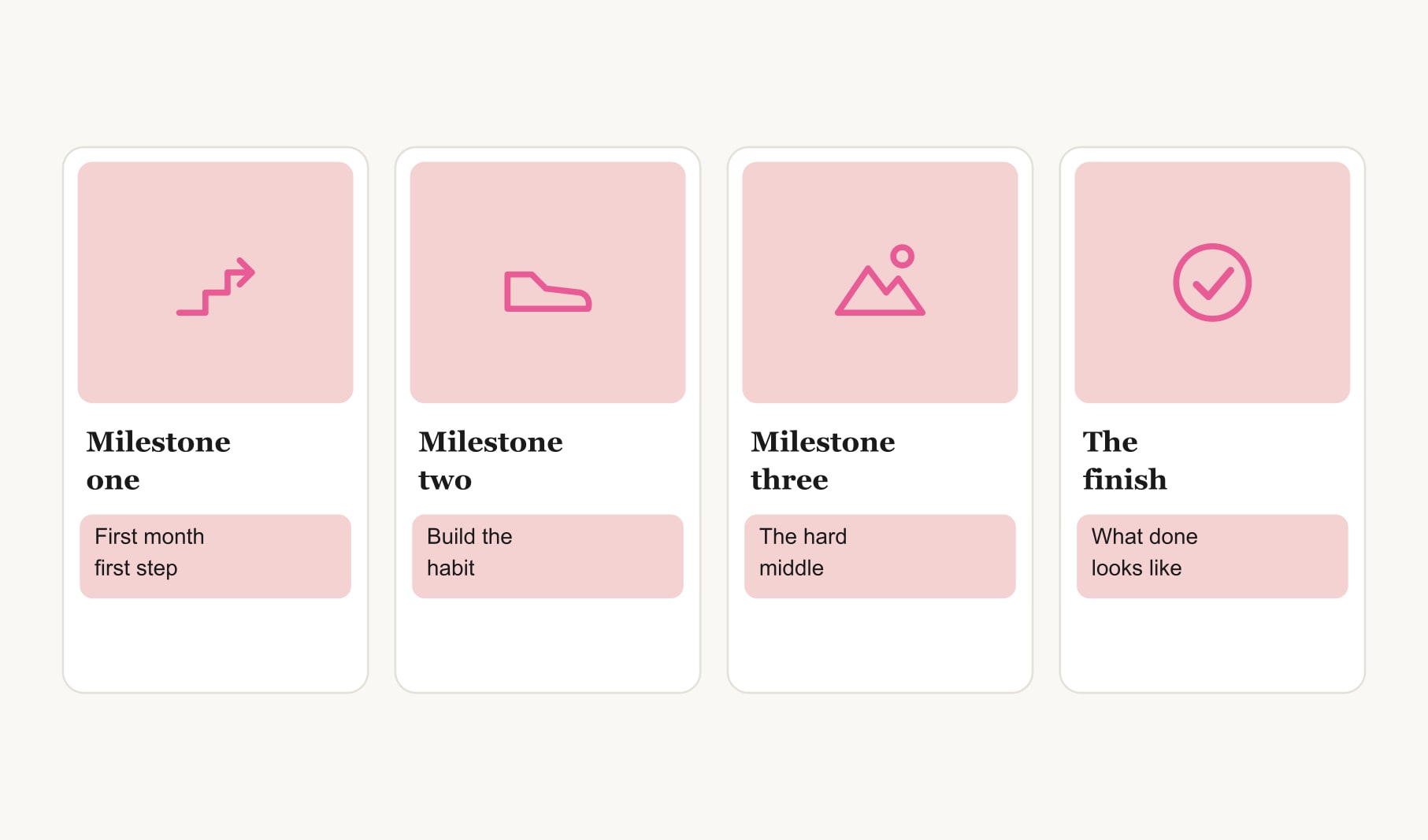
List four to six checkpoints between now and the finish, each with a month. For a half marathon: run 5k without stopping, then 10k, then 15k, then taper. For a move: choose the area, save the deposit, find the place, pack. Milestones turn a big goal into a series of smaller ones, each within reach.
Step 3: Which image goes at the finish?
A picture of the moment the goal is done: crossing the line, the certificate on the wall, the view from the new window. Place it at the top, the centre or the end of the path, wherever it will pull your eye.
Step 4: How do you picture each milestone?
One image per checkpoint, arranged in order toward the finish, like stepping stones. It is surprisingly motivating to see where you are on the path and how far you have come.
Step 5: Why name the obstacles?
Because every big goal has a hard middle. Write down what is most likely to get in the way at each stage: tiredness, time, cost, doubt, other people. Naming obstacles is not negative; it is preparation, and it makes you far more likely to keep going when they arrive.
Step 6: What is an if-then plan?
A short line that pairs an obstacle with a response: “If I miss a run, then I do ten minutes the next morning.” “If I feel stuck on an essay, then I write for fifteen minutes without editing.” Put one under each milestone. My goal setting vision board ideas explain this technique in more detail.
Step 7: What is the first step?
The smallest action you can take this week toward the first milestone. Write it under the first image. “Buy running shoes.” “Email the course office.” “Choose three towns to visit.” One small action is enough to start moving.
Step 8: How do you track progress on a goal board?
Move a marker along the path, like a pin, a sticker or a paper clip, as each milestone is reached. It is a small, satisfying ritual, and it shows at a glance how far you have come. Log small actions in a goal tracker for your vision board so you can see progress even between milestones. Review the board weekly and adjust months if needed.
What does a finished single-goal board look like?
For a half marathon: running shoes by the door (first step, this week), a park trail (5k by March), a riverside path (10k by May), a hill at dawn (15k by August) and a finish arch in a park (the race in October). An if-then line under each. A pink pin on the first image, ready to move. For more goals written out this way, see my vision board goals examples.
What if you fall behind a milestone?
Move the month, shrink the next step and keep going. Big goals rarely run to schedule, and a milestone reached late is still reached. If you fall behind twice in a row, look at the if-then plan for that stage; it may need to be simpler.
Can you have a goal board alongside a general board?
Yes. Many people keep a general board for the year and a separate goal board for their biggest project, often hung side by side or one above the other. The goal board gives that one goal the space and structure it needs, while the general board keeps the rest of life in view.
Keep reading
Making a vision board for a goal: your questions
Write the goal in one specific sentence, break it into four to six milestones with months, choose an image for the finish and one for each milestone, add if-then plans for likely obstacles, write this week’s first step and move a marker as you progress.
Four to six milestones suit most single-goal vision boards. That is enough to show a clear path from now to the finish without crowding the board. Each milestone should have its own image, a target month and an if-then plan for its likely obstacle.
An if-then plan pairs a likely obstacle with a response, such as if I miss a run, then I do ten minutes the next morning. Writing one under each milestone on a goal vision board prepares you for the hard middle stretch of a big goal.
Move a pin, sticker or paper clip along the milestone images as each one is reached, and log small daily actions in a tracker. Reviewing the goal vision board weekly keeps months realistic and shows how far you have already come.
Big goals with several stages suit a whole vision board, such as running a race, finishing a qualification, moving home, starting a business or completing a creative project. Smaller goals usually fit better as one square on a general board instead.
Yes. Many people keep a general vision board for the year and a separate goal vision board for their biggest project. The goal board gives that project space and structure, while the general board keeps the rest of your life in view.
Choose a picture of the moment the goal is done, such as crossing a finish line, a certificate on the wall or the view from a new home. Place it where it pulls your eye, at the top, the centre or the end of the milestone path.
Keep your vision board alive
A board built in your browser resets when you close the tab. Vision Boardly saves your boards, reminds you as each vision date arrives, and tracks the habits and moods moving you toward them.
Get Vision Boardly Free