
Do Vision Boards Work
Do Vision Boards Work
My honest answer: yes, if you use one as the start of a plan. Here is what the research actually says.
Do vision boards work? They can, as a focus tool rather than a shortcut. Research suggests specific goals and if-then plans improve follow-through, while simply fantasising about success can sap motivation. A board that pairs each image with a date and a first step uses the helpful part and avoids the trap.

Do vision boards work? It is the question I get asked most, usually with a slightly sceptical eyebrow. My honest answer, after years of making them and reading the research behind them: yes, when you use them as the start of a plan. No, when you expect the pictures to do the work.
What does research say about vision boards?
There is little research on vision boards as such, but a lot on the ingredients they use: goals, visualisation and planning. The findings point in a consistent direction.
- Specific goals help. Decades of goal setting research find that clear, specific goals beat vague ones.
- Plans help more. Studies on implementation intentions, if-then plans that say when and where you will act, show they improve follow-through.
- Pure fantasy can backfire. Work by the psychologist Gabriele Oettingen suggests that indulging in positive fantasies about a perfect outcome can reduce the energy people put into reaching it.

So do vision boards work or not?
Put those findings together and you get a clear picture. A board that is only a beautiful collage of dream outcomes risks the fantasy trap: it feels good, and that good feeling quietly replaces effort. A board where each image carries a specific goal, a date and a first step uses the parts that research supports. The difference is not the board. It is what you write underneath.
Why do vision boards seem to work for some people?
Because those people usually do three things without thinking about it. They choose a few goals they genuinely want. They look at the board often, so the goals stay front of mind when small choices come up. And they act, even in tiny ways, week after week. The board is a reminder system for all three. If you want to understand why the reminder part matters, my guide to how vision boards work explains the mechanism.
What does a vision board that works look like?
Here is one from a friend who swore boards were nonsense until trying it my way. Four images. A pair of trainers: run three times a week, first step, lay the kit out on Sunday night. A desk: finish the online course by the end of term, first step, lesson one on Monday. A jar of coins: a weekly money check-in on Fridays. A beach: a week away in the summer, first step, agree dates with the family. My friend checked it every Sunday. By the end of the season three of the four were done, and the grudging verdict was that the board had helped. Not through anything mysterious, but because it kept four clear decisions in view every single day.
Notice what that board did not have: no mansion, no sports car, no perfect body. Just four things that mattered, each small enough to start that week. That is what a working board looks like most of the time. Unremarkable to anyone else, and quietly powerful for the person who made it.
Why do vision boards not work for some people?
Usually for one of four reasons. Too many goals, so nothing gets attention. Goals borrowed from someone else, so there is no real pull. No plan underneath, so the picture never turns into a Tuesday. Or the board goes behind a door and is never seen again. Each of those is fixable in an afternoon.
How do you make a vision board work for you?
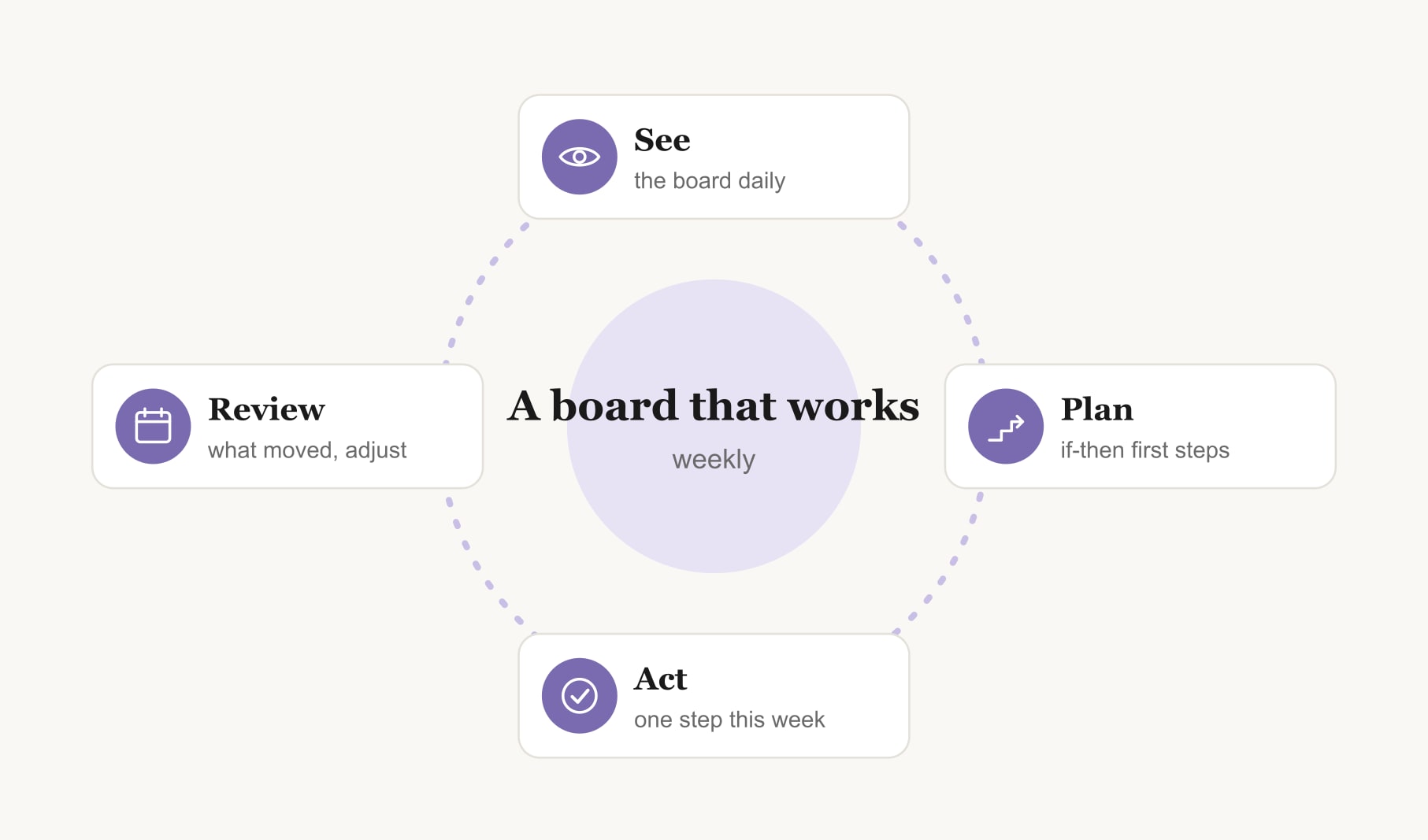
Keep three to five goals. Write a specific goal and a first step under each image. Put the board somewhere you see it every day. Then check in once a week: what moved, what is next, what needs a new date. Tracking the small actions in a goal tracker for your vision board makes progress visible, which is its own motivation. For the full method, see how to make a vision board that really works.
Do vision boards work for manifestation?
Many people use boards within a manifestation or spiritual practice, and find meaning and focus in that. I would not claim a board brings outcomes on its own, and I would be wary of anyone who promises that. What I can say is that the practical ingredients above work whatever you believe about how goals come to you. Pair your practice with a plan, and you have the best of both.
If you want to test whether your own board is working, try the simple thirty day check in my guide to whether a vision board works for you.
Keep reading
Do vision boards work: your questions
Vision boards can work as a focus tool when each image is paired with a specific goal, a date and a first step. Research supports specific goals and if-then plans, while suggesting that fantasising about outcomes alone can reduce effort. The plan underneath matters most.
There is little research on vision boards themselves, but strong research on their ingredients. Specific goals and if-then plans improve follow-through, while pure positive fantasy can sap motivation. A vision board built around goals and first steps uses the supported parts.
Vision boards often fail because of too many goals, goals borrowed from other people, no plan beneath the images, or a board kept out of sight. Each of these is easy to fix by narrowing to a few genuine goals, adding first steps and keeping the board visible.
There is no fixed timeline. Small habit goals on a vision board can show progress within a week or two, while bigger goals may take months. Weekly check-ins help you notice progress early and adjust dates, which keeps motivation steady along the way.
Many people use vision boards within a manifestation practice and find focus and meaning there. A board does not bring outcomes on its own, but pairing your practice with specific goals and first steps gives it practical strength, whatever you believe about how goals come to you.
A vision board is more likely to work when it holds three to five goals you genuinely want, each with a specific goal, a date and a first step, and when you see it every day and review it weekly. Tracking small actions adds momentum too.
A vision board is rarely harmful, but it can backfire if it becomes a substitute for effort or fills you with comparison and guilt. Keep images personal and kind, pair them with actions, and remove anything that makes you feel worse rather than hopeful.
Keep your vision board alive
A board built in your browser resets when you close the tab. Vision Boardly saves your boards, reminds you as each vision date arrives, and tracks the habits and moods moving you toward them.
Get Vision Boardly Free