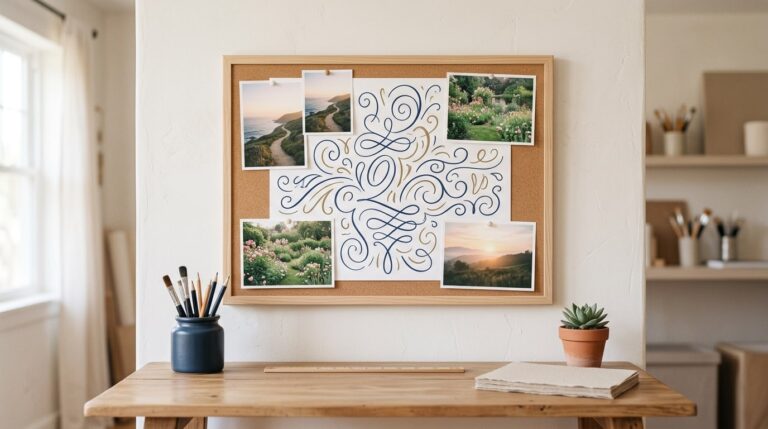
How Do Vision Boards Work
How Do Vision Boards Work
No mystery required. Here are the five ordinary ways a board changes what you notice and do, and the one way it can backfire.
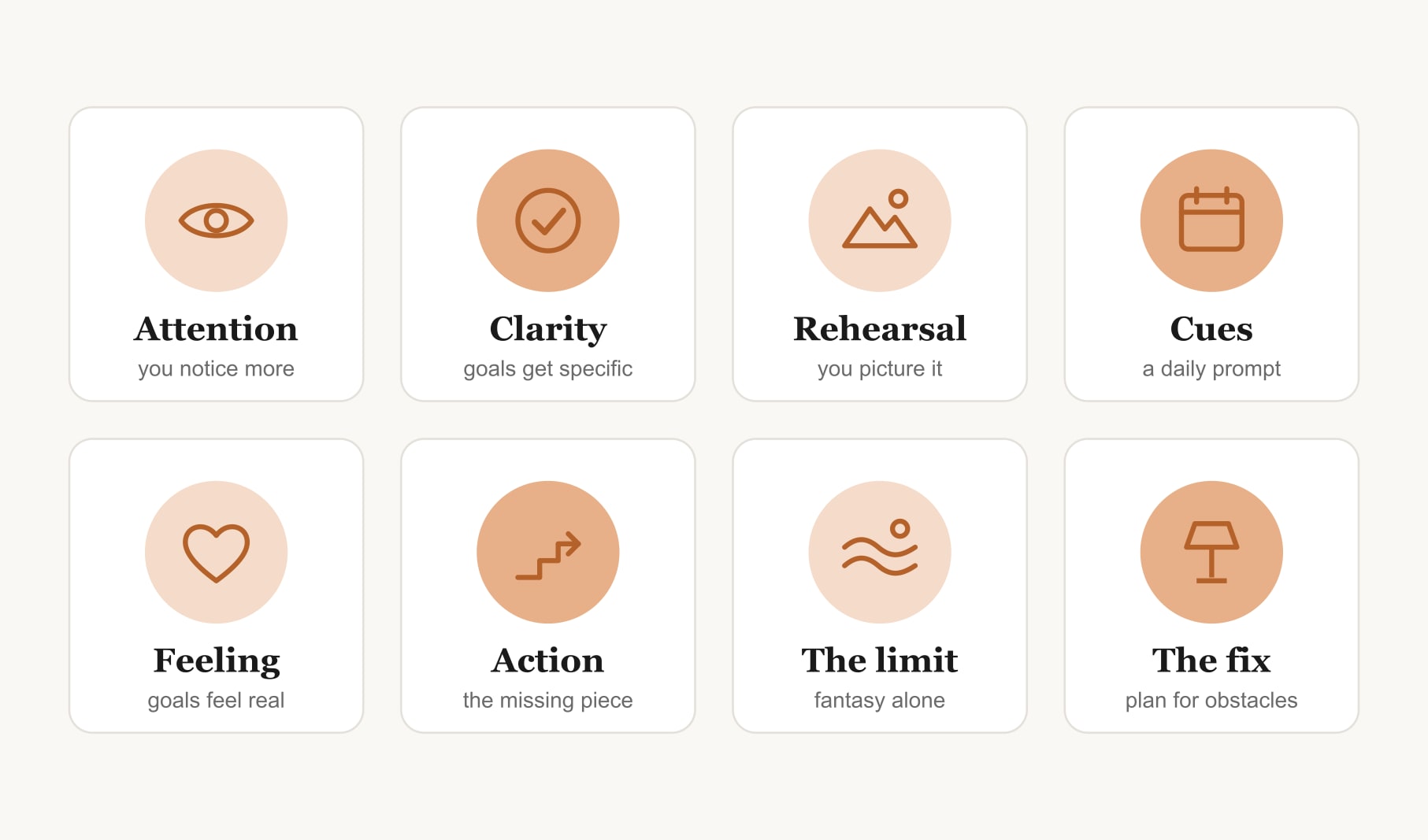
Vision boards work through five ordinary mechanisms: they direct your attention toward goal-related chances, make goals clearer, let you mentally rehearse success, act as a daily cue for small actions and connect goals to feelings. They can backfire if picturing replaces effort, so pair the board with obstacle planning and daily action.

People often ask me “how do vision boards work?”, half expecting a mystical answer. The truth is more ordinary, and I think more useful. A board changes what you notice, how clear your goals are and how often you act on them. Here are the five mechanisms, plus the one way boards can backfire. If you want to know whether they work at all, I have covered the evidence in do vision boards work.
How do vision boards work on your attention?
Your brain filters out most of what surrounds you and keeps what seems relevant. Attention is selective. When you look at a goal every day, it becomes more relevant, so you tend to notice related chances: a course advertised, a conversation, a house for sale on a street you love. The chances were always there. The board simply helps you see them, and a chance you notice is one you can act on.
How do boards make goals clearer?
Choosing one image for a goal forces a decision. “Travel more” becomes a particular beach. “Get healthier” becomes a particular path. Specific goals are easier to act on than vague ones, and the act of making the board does that sharpening for you.
What is mental rehearsal?
When you picture yourself doing something, some of the same processes run as when you actually do it. Athletes use this to prepare. Looking at a board and imagining the goal done is a gentle form of rehearsal, which can make the real thing feel more familiar and less daunting.
How does a board act as a daily cue?
Habits start with a cue. A board you pass every morning is a visible prompt: see the running path, put on your trainers. Without a cue, good intentions depend on memory, which is unreliable on busy days.
Why does feeling matter?
Images carry emotion in a way lists do not. A picture of the calm kitchen you want makes the goal feel real and worth the effort, and it reminds you why you started when the work gets repetitive or slow. That feeling is often what gets you through the dull middle of a long goal.
How can vision boards backfire?
If picturing the goal feels so satisfying that it replaces effort. Research by Gabriele Oettingen suggests that pure positive fantasy can sometimes lower motivation, because the mind enjoys the imagined success a little too much. It is the one real limit of a board, and it is worth taking seriously.

How do you get around the limit?
Pair every image with an obstacle and a plan. Picture the goal, then ask what inside you might get in the way, then write an if-then line. And take one small action each day. My guide on how to make a vision board that really works walks through this step by step.
What is the missing piece most people forget?
Action. All five mechanisms make action more likely, but none of them replaces it, however beautiful the board. The board is the prompt; you are the one who moves. A habit tracker for your vision board closes the loop by showing you the actions add up.
Why do some boards work better than others?
The boards that work best share a few features. They hold a handful of specific goals rather than dozens of vague ones. They sit somewhere seen daily. Each image has a date and a first step. And the owner pairs the board with a small daily action and a weekly review. Every one of those features strengthens one of the five mechanisms above.
Does the type of board matter?
Less than you might think. Paper, digital, cork or lock screen all work through the same mechanisms. What matters is that you see it often, that the goals are clear and that it prompts action. Choose the format you are most likely to look at every day, and if one stops working, try another rather than giving up on the idea.
How does this fit with manifestation?
People who see vision boards as a spiritual practice often describe the same loop in different words: intention, feeling, aligned action and noticing signs. Whatever your beliefs, the daily habit looks much the same. My guide on how to manifest a vision board sets out that daily practice.
How do you test whether it works for you?
Run a thirty-day experiment with three goals, a daily glance and one small action a day, then count. My guide to whether vision boards work for you has the full test.
Keep reading
How do vision boards work: your questions
Vision boards work by directing your attention toward goal-related chances, making goals clearer, letting you mentally rehearse success, acting as a daily cue for small actions and connecting goals to feelings. Pairing the board with daily action is what makes these effects count.
Partly, yes. Attention is selective, so when you look at a goal every day it becomes more relevant and you tend to notice related chances, such as a course or a conversation. A vision board helps you see opportunities that were already there.
Vision boards can backfire if picturing the goal feels so satisfying that it replaces effort. Research suggests pure positive fantasy can sometimes lower motivation. Pairing each image with an honest obstacle, an if-then plan and a small daily action helps avoid this.
Mental rehearsal means imagining yourself doing something, which runs some of the same processes as actually doing it. Looking at a vision board and picturing a goal done is a gentle form of rehearsal that can make the real thing feel more familiar.
A visible vision board acts as a daily cue. Habits start with a prompt, and a board you pass every morning reminds you to take a small step. Without a visible cue, good intentions depend on memory, which is unreliable on busy days.
Vision boards rarely work without action. They make action more likely by focusing attention, clarifying goals and providing daily cues, but none of those replaces the small steps you take. The board is the prompt, and progress comes from acting on it.
Run a thirty-day experiment with three goals on a vision board you see daily, one small action a day and a weekly check-in. At the end, count your actions and compare them with a normal month to see whether the board made a difference.
Keep your vision board alive
A board built in your browser resets when you close the tab. Vision Boardly saves your boards, reminds you as each vision date arrives, and tracks the habits and moods moving you toward them.
Get Vision Boardly Free