Vision Board With Words and Pictures
Pictures carry the feeling, words carry the plan. Here is how to balance the two so the board reads in seconds.
A vision board with words and pictures works when each does its own job: pictures show concrete goals like places and rooms, words name feelings, habits and dates. Aim for one guiding word, a short caption under each image with the goal, a month and a first step, and roughly four images for every block of text.
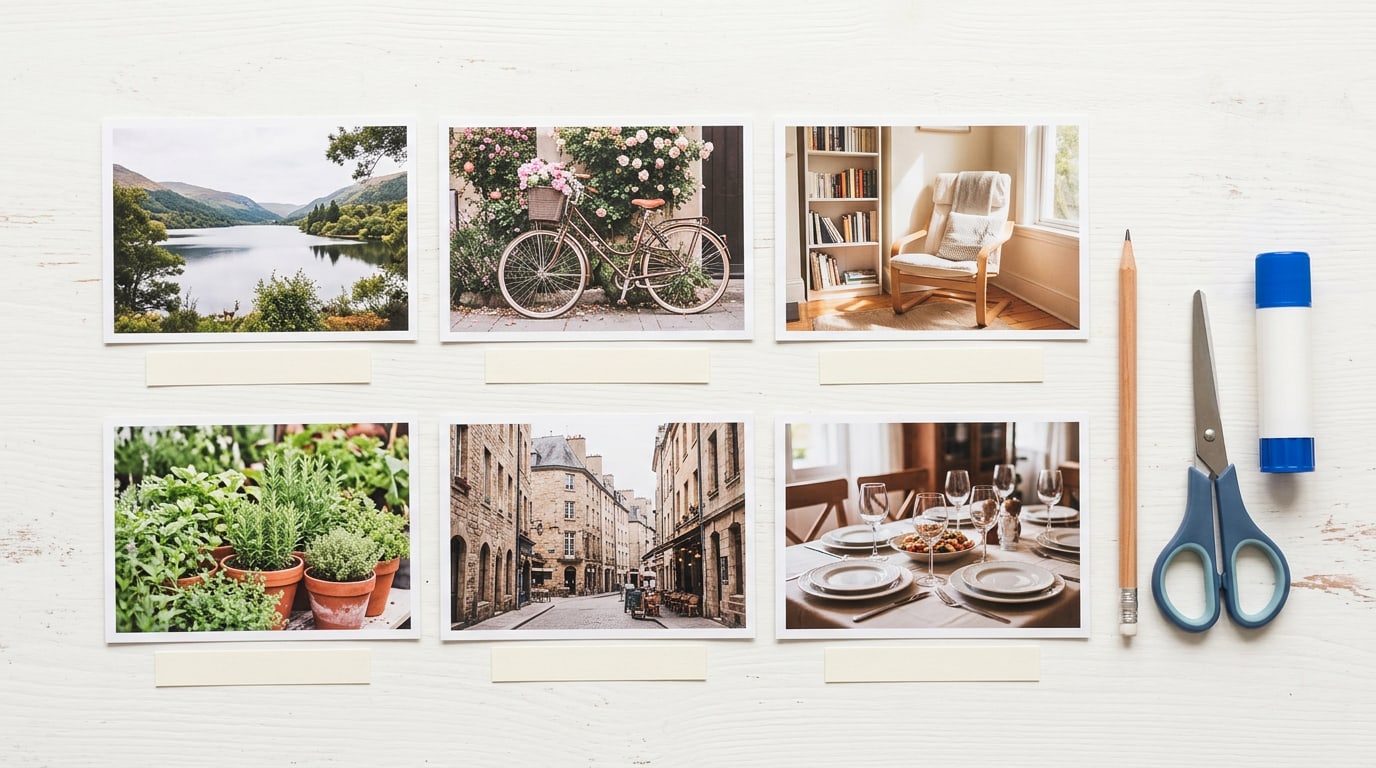
A board of only pictures can be beautiful and vague. A board of only words can be clear and a little cold. Most people land in the middle, and that is where the real choices are. A vision board with words and pictures works when each does a different job: pictures carry the feeling, words carry the plan. Here is how I decide which goals get which, the caption formula I use under every image and how to place everything so it reads at a glance.
What does each part of a vision board with words and pictures do?
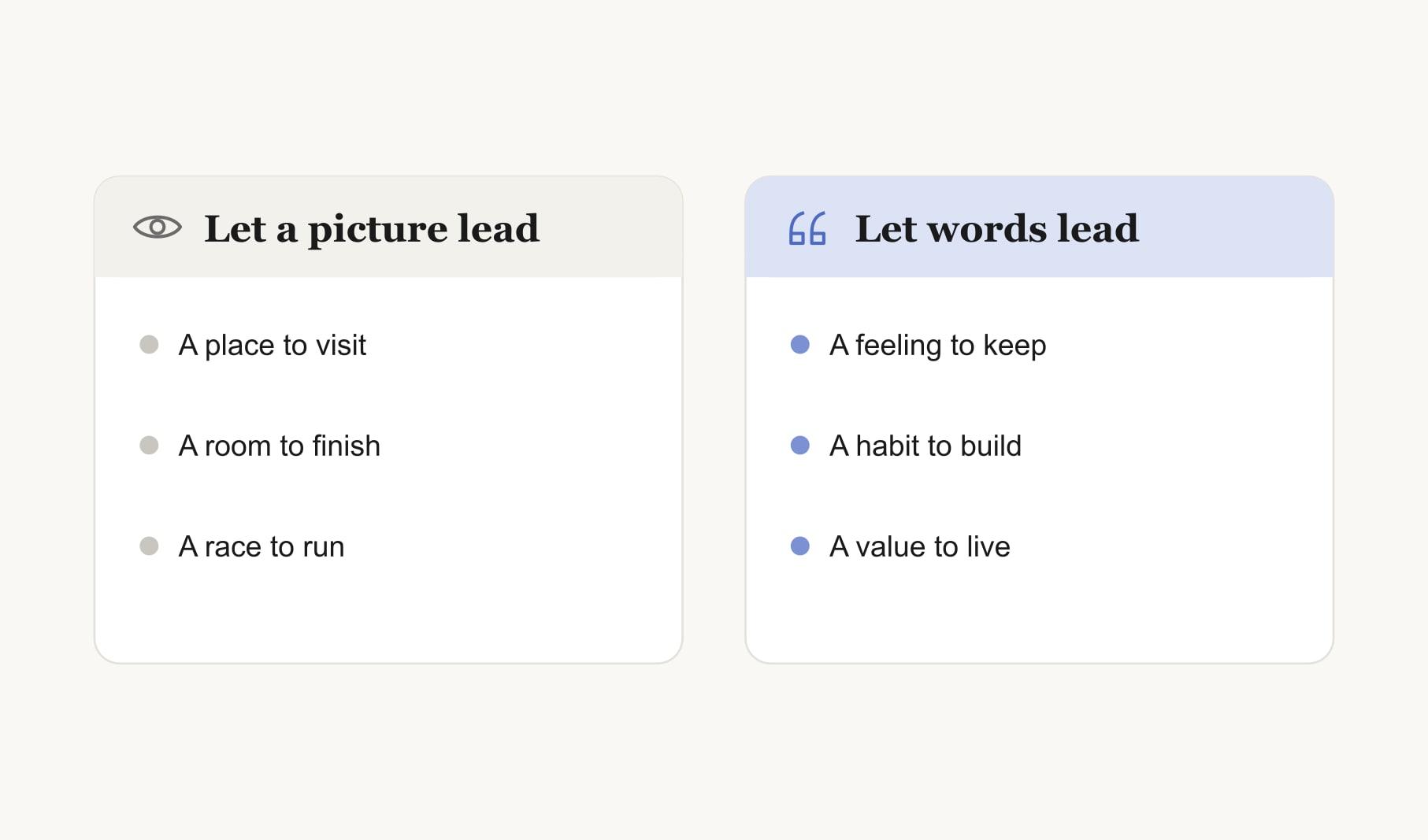
Pictures work on your feelings. A photo of a sunlit kitchen makes you want the kitchen before you have read a word. Words work on your actions. “Repaint by May, first step: choose the colour this weekend” tells you exactly what to do. The best boards use both on purpose, so each image has a reason to be wanted and each goal has a way to be reached.
Which goals need a picture and which need words?
Concrete goals want a picture: places, rooms, objects, events. A trip to Lisbon, a finished garden, a 10K race. You can photograph them, and seeing them makes them real. Abstract goals want words: feelings, habits and values. Calm, patience, an earlier bedtime, kindness at work. Photos of abstract ideas tend to be vague, so name them instead.
If you are short on images for the concrete ones, browse vision board images by theme, or start from your own camera roll.
What is the caption formula?
Under every picture, write three short things: the goal, a month and a first step. “Lisbon, September. First step: open a travel savings pot.” “Kitchen, May. First step: pick the paint.” It takes ten seconds to read and turns a pretty photo into a plan. Keep captions to one or two lines in a plain font. They should feel like gallery labels, not paragraphs.
For more on what earns a place on a board in the first place, see my guide to what to put on a vision board.
What is the right ratio of words to pictures?
A useful rule: roughly four images for every block of text, not counting captions. On a nine-square board, that means seven picture squares and two word squares, often a guiding word and one abstract goal. On a freer collage, it means one cluster of words for every few images. If words start covering more than a third of the board, it will read as a page of notes rather than a picture of your year.
Where should words sit in relation to pictures?
Captions go directly under their image, aligned to its left edge, so there is never doubt about which words belong where. A guiding word goes at the top or in the centre, larger than anything else. Word squares sit among picture squares rather than bunched in one corner, so the eye moves smoothly across the board. Avoid placing text over busy parts of an image; put it on sky, sand or a plain wall if it must overlap.
A vision board builder with a grid takes care of most of this, because every square already has a slot for a caption and a date.
How should the words look?
Choose one font for captions and, at most, one more for the guiding word. Keep captions dark on light. Make the guiding word big enough to read from across the room. Match its colour to a shade that appears in your photos, which ties words and pictures together visually. Handwriting works beautifully too, as long as it is legible.
What does a balanced board look like?
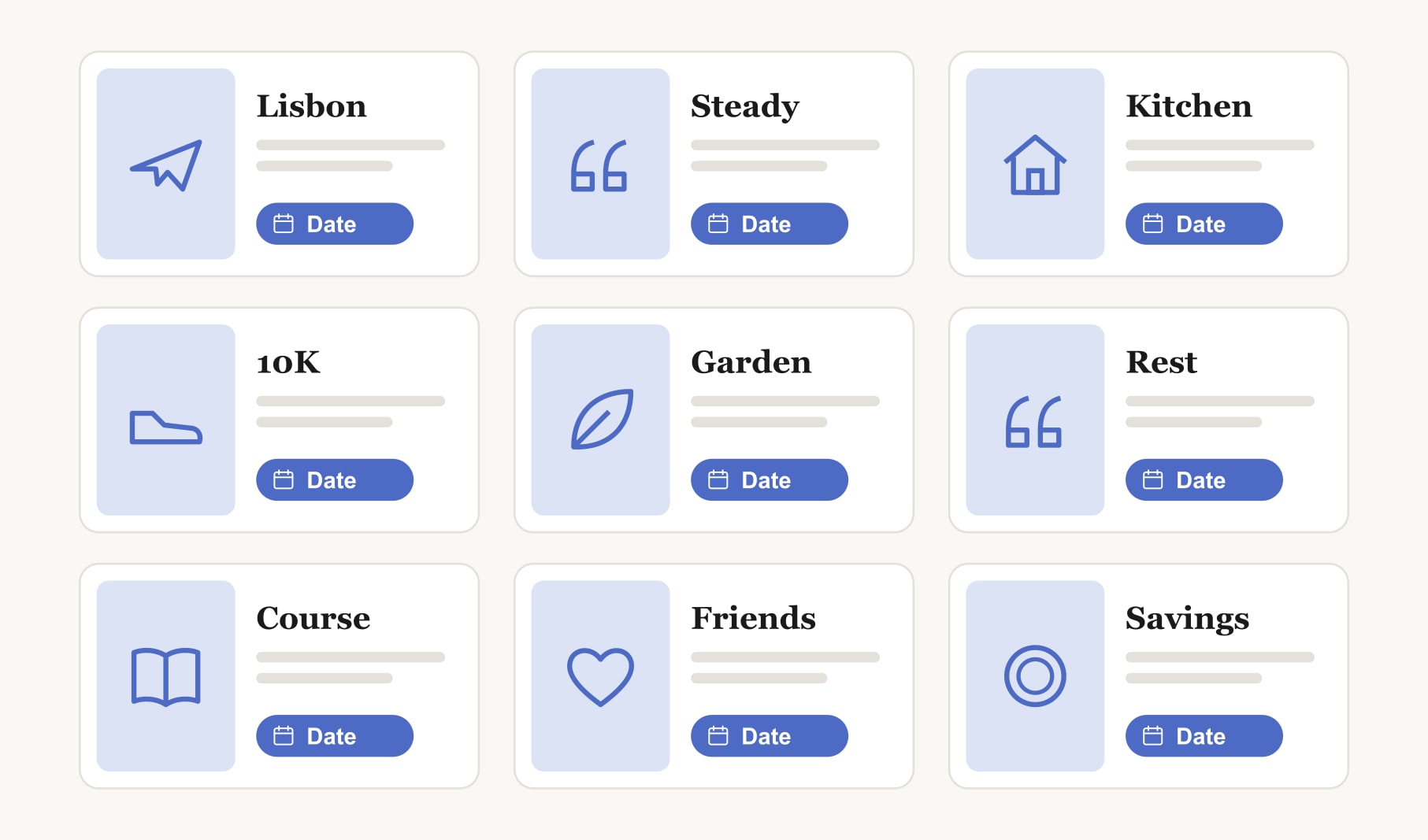
A three by three grid. In the centre, the word “steady” in a large serif. Around it, a Lisbon street, a sunny kitchen, a race finish line, a herb garden, a course workbook, a table of friends and a savings jar, each with a short caption and month. One more word square, “rest”, sits beside the kitchen, for the earlier nights that are hard to photograph. Nine squares, two words, seven pictures, and every one has a date.
What mistakes make words and pictures clash?
The most common is captions in tiny type that nobody can read from more than a step away. Next is text dropped on top of a busy photo, so neither the words nor the image comes through. Then there are boards where every square has a quote, a caption and a sticker, and the eye has nowhere to rest. Finally, words and pictures that disagree, such as a calm beach photo with the caption “work harder”. Each is easy to fix once you spot it. Step back, read the board from the door, and adjust whatever you cannot take in at a glance.
How do you keep words and pictures working together?
Review the captions every month. The pictures rarely need changing, but the first steps do: once one is done, write the next. A goal tracker for your vision board keeps those steps in one list so the captions stay current. When a goal is finished, keep the picture up for a week to enjoy it, then swap both the image and its words for the next vision. That rhythm is what keeps a vision board with words and pictures alive all year.
Keep reading
Vision board with words and pictures: your questions
Let pictures show concrete goals such as places and rooms, and let words name feelings, habits and dates. Aim for roughly four images for every block of text on your vision board, plus a short caption under each picture with the goal, a month and a first step.
A good vision board caption says three things: the goal, a month and a first step, such as "Kitchen, May. First step: pick the paint." Keep it to one or two lines in a plain font, so it reads like a gallery label rather than a paragraph.
Abstract goals such as calm, patience, an earlier bedtime or kindness at work are hard to photograph, so name them with words on your vision board. Concrete goals like a trip, a room or a race are easier to show with a picture.
Put captions directly under their image, aligned to its edge, and place a guiding word at the top or centre in larger type. Spread any word squares among the pictures on the vision board, and avoid setting text over busy parts of a photo.
Keep words to captions, one guiding word and one or two word squares. If text covers more than about a third of the vision board, it starts to read like a page of notes, and the pictures lose their power to pull you in.
Yes. Handwriting makes a vision board feel personal and pairs well with printed photos. Keep it legible, write captions in a dark pen on a light background and make the guiding word large enough to read from across the room.
Keep your vision board alive
A board built in your browser resets when you close the tab. Vision Boardly saves your boards, reminds you as each vision date arrives, and tracks the habits and moods moving you toward them.
Get Vision Boardly Free