
Business Vision Board Ideas
For founders, freelancers and side projects: a board that keeps the business goals in view without losing sight of the life around them.
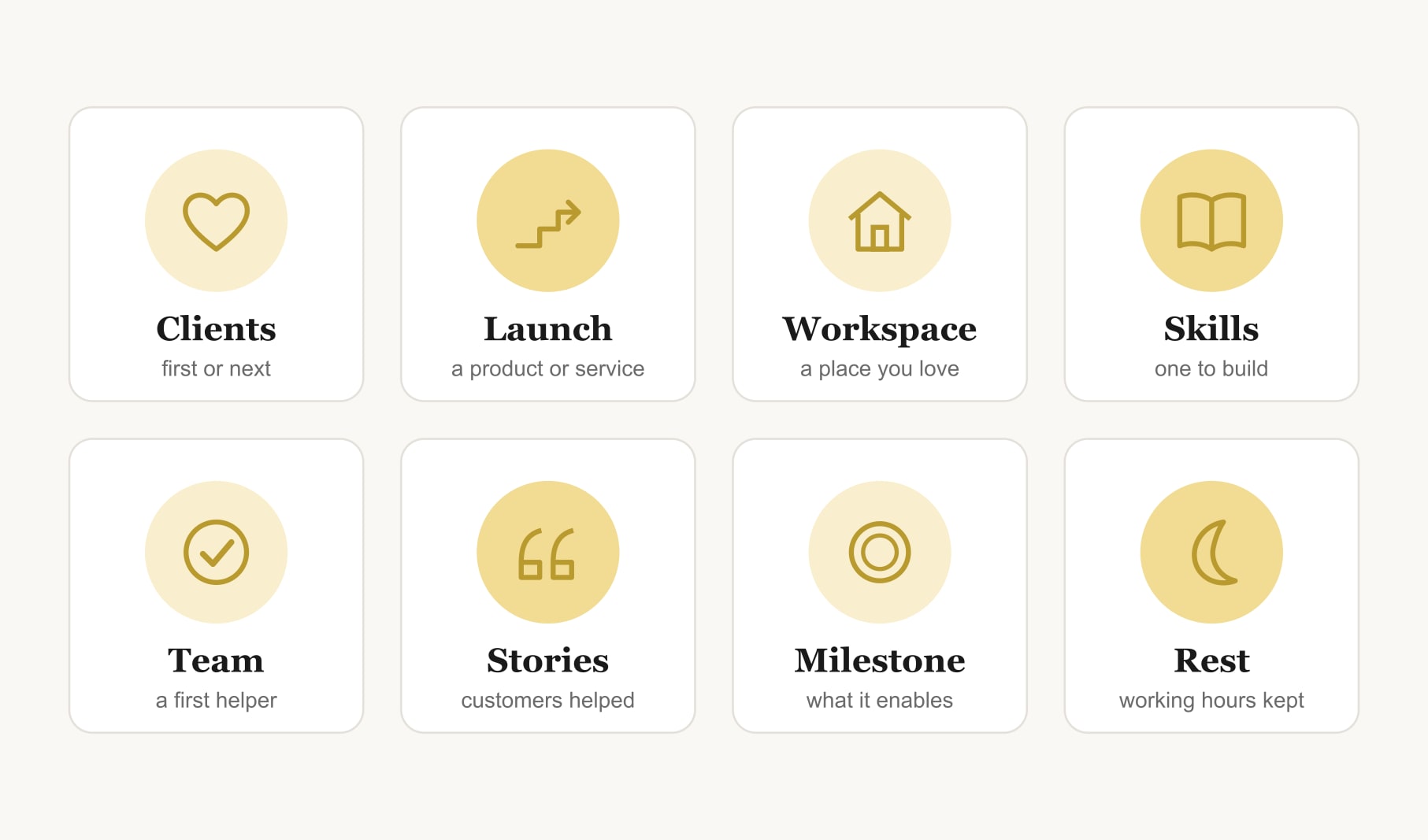
Good business vision board ideas include your first or next clients, a product or service launch, a workspace you love, a skill to build, a first hire or collaborator, customer stories you want to earn, a revenue milestone pictured as what it enables, clear working hours and proper rest. Give each a month and a first step.

Business boards are some of my favourites to make, because the goals are so concrete. They are also where I see the most hype: luxury cars, huge numbers and always-on slogans. These business vision board ideas are the opposite: grounded, specific and built around a business that fits the life you want. They work for founders, freelancers and side projects alike.
What are the best business vision board ideas?
- Clients. Your first client, your next three, or the kind of client you want more of.
- A launch. A product, a service, a website or a shop, with a target month.
- A workspace. A desk by a window, a studio, a stall, a small unit.
- A skill. Selling, writing, bookkeeping, a trade skill, public speaking.
- A team. A first freelancer, an assistant, a collaborator.
- Customer stories. The kind of thank-you message you want to earn.
- A milestone. Pictured as what it enables: paying yourself properly, a first hire, a calmer month.
- Rest. Working hours you protect, a real holiday, weekends off.
How do you picture business goals?
Show the moment the goal is real, from where you would stand. A packed parcel on its way to a customer. A calendar with three client calls. A café table set for a meeting. Your own workspace, tidied and ready. Real, specific images motivate far more than stock photos of skyscrapers. Photograph your own products, your own desk and your own town; they remind you that the business is real and already underway.
Should money goals go on a business board?
If they matter to you, yes, pictured as what they make possible rather than as figures. Paying yourself a steady wage, hiring help, taking a proper holiday. Keep exact numbers in your planning documents. These are ideas for your board, not financial or business advice.
How does a board fit with a business plan?
A business plan is detailed; a board is visual and daily. Many founders start with a short vision statement, one sentence on what the business is for, and put it across the top of the board. The images beneath show the milestones that make the statement real.
What does a finished business board look like?
Here is one a freelance designer made. Across the top: “Good work for good people, four days a week.” Beneath it, six images. A laptop-free desk by a window: a tidy studio corner by March. A café table for two: three new clients by summer, first step, email five old contacts. A packed parcel: a small print shop launched by autumn. A notebook and pen: a bookkeeping course. A calendar with Fridays blank: four-day weeks from June. A beach: two weeks off in August.

What should you leave off a business board?
Luxury images that have nothing to do with why you started. Other founders’ success presented as the standard. Figures you would be embarrassed to miss. And any goal you are only chasing because someone online said you should. A business board should pull you toward the business you actually want to run.
Can a side project have a board?
Absolutely, and it often needs one more than a full-time business, because side projects get squeezed by everything else. Keep it small: three goals, a realistic month for each, and one protected evening a week. A board is a lovely way to keep a side project from quietly drifting.
Why include rest on a business board?
Because burnout ends more small businesses than competition does. Protected hours and real holidays keep you able to do good work for years. If the rest square feels indulgent, remember it is there to protect every other square.
How do you track business goals from the board?
Break each into monthly milestones and log them in a goal tracker for your vision board. Review weekly: which first step happened, what is next, what needs to shift. A board you review weekly becomes a simple planning tool, not just decoration.
Can employees use a business board too?
Yes, for career goals within a role or a team, and many managers make one with their team at the start of a year. My vision board ideas for career cover individual moves, and my vision board ideas for work cover team boards. For money goals outside the business, see my guide to vision board financial goals.
Keep reading
Business vision board ideas: your questions
Good business vision board ideas include your first or next clients, a product or service launch, a workspace you love, a skill to build, a first hire or collaborator, customer stories you want to earn, a milestone pictured as what it enables and protected rest.
Write a one-sentence vision for the business, then choose five to eight goals such as clients, a launch and working hours. Find an image from inside each goal, add a target month and first step, and review the business vision board every week.
If revenue matters to you, picture it on your business vision board as what it enables, such as paying yourself properly or hiring help, rather than as a figure. Keep exact numbers in your planning documents and treat the board as a personal aim, not advice.
Images that show the moment a goal is real work best on a business vision board, such as a parcel on its way to a customer, a café table set for a client meeting or your own tidy workspace. Specific images motivate far more than generic stock photos.
Rest belongs on a business vision board because burnout ends many small businesses. Protected working hours, weekends off and a real holiday keep you able to do good work for years, which protects every other goal on the board as well.
A business plan is detailed and occasional, while a business vision board is visual and daily. Many founders put a one-sentence vision statement at the top of the board and use the images below to show the milestones from the plan.
Review a business vision board weekly for about ten minutes. Check which first steps happened, choose the next ones and adjust milestone months if needed. A weekly review turns the board into a simple planning tool rather than decoration on the wall.
Keep your vision board alive
A board built in your browser resets when you close the tab. Vision Boardly saves your boards, reminds you as each vision date arrives, and tracks the habits and moods moving you toward them.
Get Vision Boardly Free