
Vision Board Financial Goals
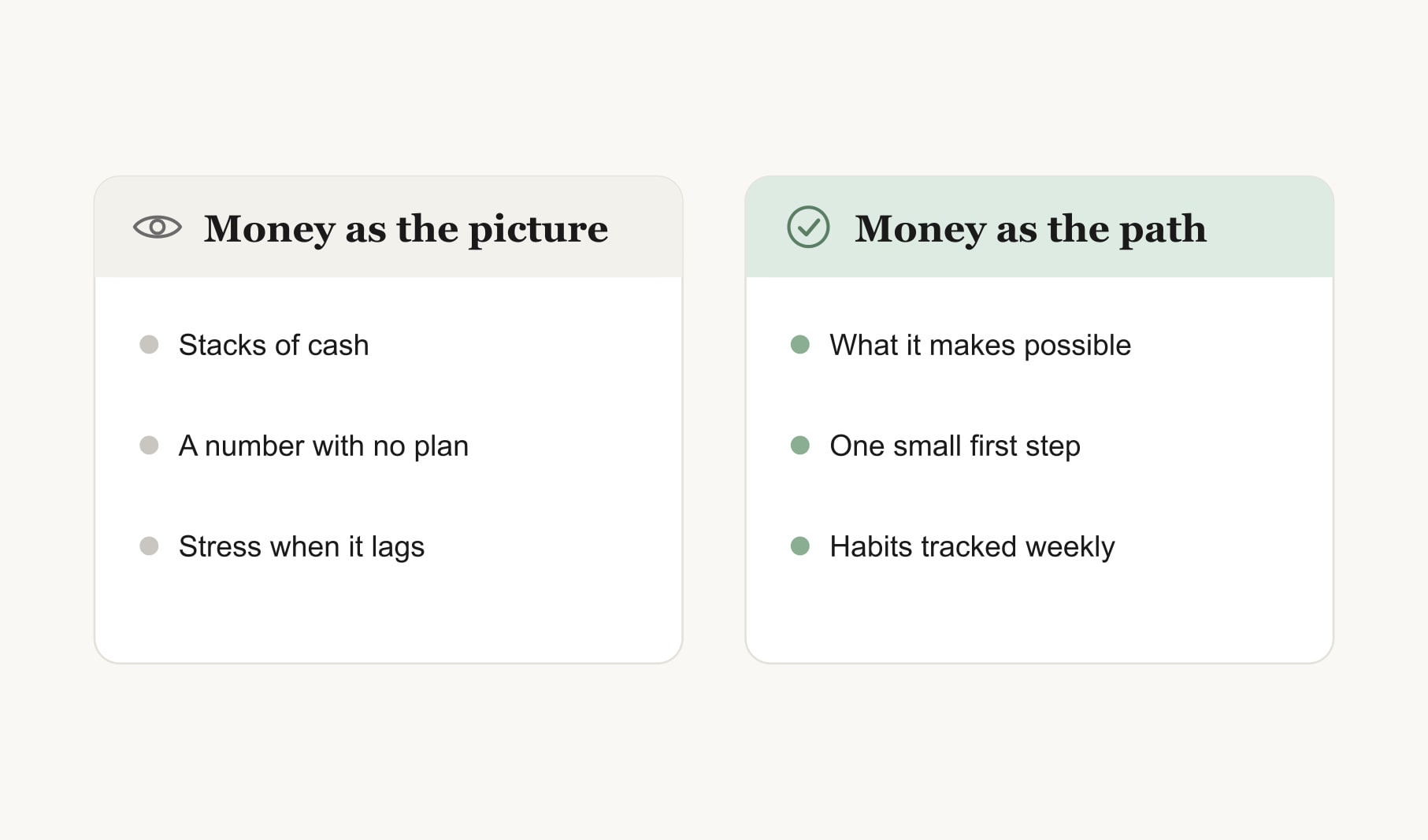
Money goals work best on a board when you picture what they make possible, not the money itself.
Good vision board financial goals picture what money makes possible rather than cash itself: a calm emergency fund, a paid-off card, a trip saved for, a home deposit or giving to a cause you love. Give each a first step and a month, track small money habits weekly, and treat it as a personal aim.

Money goals can make a board feel stressful, or they can make it feel calm and hopeful. The difference is almost always in how they are pictured. These vision board financial goals focus on what money makes possible, with one practical step each. A quick note first: these are ideas for your board, not financial advice, so please talk to a qualified adviser for decisions about your own money.
What are good vision board financial goals?
- A safety net. An emergency fund pictured as a calm home, not a number.
- One debt gone. A single balance paid off, pictured as a weight lifted.
- A trip saved for. The beach or city, paid for before you go.
- A home deposit. A front door you hope will one day be yours.
- Giving. A cause, a charity or a person you want to support.
- Money skills. Learning to budget, understand pensions or read a payslip.
- A weekly money date. Fifteen calm minutes checking in with your money.
- Fewer money worries. Pictured as a quiet evening with nothing nagging at you.

Why picture what money makes possible?
Because a stack of cash on a board rarely motivates anyone for long, and it can make you feel worse on tight months. A picture of a calm evening, a trip or a front door connects the goal to how you want to live. That connection is what keeps you going when saving feels slow.
How do you make financial goals specific?
Add what, by when and how. “Build a safety net” becomes “three months of essentials saved by next winter, saving a set amount each payday”. You do not need to write figures on the board if you prefer to keep them private. Write them in a notebook and put the picture and the month on the board.
What first steps suit financial goals?
Small, concrete and doable this week. Set up an automatic transfer on payday. List every debt in one place. Cancel one regular payment for something you no longer use. Open a separate savings pot and give it a name. Book fifteen minutes on Sunday for a money check-in. First steps like these build momentum without needing a big change.
How do you track financial goals without stress?
Track habits, not just totals. Did you do the weekly money check-in? Did the transfer go through? Did you pack lunch three times? A habit tracker for your vision board shows progress on weeks when the total barely moves. Totals move slowly; habits move every day.
How do you review financial goals through the year?
Once a month, over a cup of something nice, look at each money goal. What moved? Did the automatic transfer keep going? Is a goal still right for you? Adjust dates without guilt, since money goals often take longer than planned when life gets expensive. Every quarter, celebrate progress, even small progress, by moving a marker or adding a sticker beside the image. Celebrating keeps money goals feeling hopeful rather than heavy.
What if money is tight right now?
Then keep the goals gentle and the steps tiny. A goal like “know exactly where my money goes” or “save a small amount each week, however little” is a real goal. Knowing your numbers is a kind of calm in itself. The board can still hold a bigger dream for later, pictured as something to look forward to rather than something you are behind on.
What should you leave off a financial vision board?
Images of luxury you do not really want, comparisons with other people’s lifestyles and anything that promises quick money. If an image makes you feel behind rather than hopeful, it does not belong. The board is for your calm, not for keeping up with anyone.
Can couples or families share financial goals on a board?
Yes, and it can make conversations about money much easier. Agree the goal together, picture what it makes possible, and add one shared step like a monthly money chat. Keep personal spending goals separate if you prefer.
What does a finished financial goals board look like?
Here is a calm example. A cosy living room at night: a safety net built by winter, first step, a set transfer every payday. A beach: a summer trip paid for in advance. A card cut in half: one balance cleared by autumn. A charity shop window: giving a little each month. A cup of coffee on a Sunday: the weekly money date. Five squares, no stacks of cash, and every one of them moving. For more goals written out in full, see my vision board goals examples, and for goals across every area of life, see my guide to vision board goals.
Keep reading
Vision board financial goals: your questions
Good vision board financial goals include an emergency fund, one debt paid off, a trip saved for in advance, a home deposit, regular giving, learning money skills, a weekly money check-in and fewer money worries. Picture what each makes possible rather than the money itself.
Picture what each financial goal makes possible, such as a calm home for an emergency fund. Write a target month and one small first step under each image on your vision board, and keep exact figures in a private notebook if you prefer.
Pictures of cash rarely motivate for long and can make tight months feel worse. Images of what money makes possible, like a trip, a front door or a quiet evening, usually work better on a vision board because they connect the goal to how you want to live.
Good first steps are small and doable this week: set up an automatic transfer on payday, list every debt in one place, cancel a regular payment you no longer use, open a named savings pot or book fifteen minutes on Sunday for a money check-in.
Track money habits as well as totals. Note whether the weekly check-in happened, whether the transfer went through and how often you stuck to your plan. Habits show progress on your vision board goals even in weeks when the total barely moves.
No. A vision board is a personal tool for keeping financial goals visible and connected to the life you want. For decisions about savings, debt, investing or pensions, speak to a qualified financial adviser who can look at your own situation.
Yes. Couples can agree shared financial goals, picture what they make possible on a vision board and add one shared step like a monthly money chat. Personal spending goals can stay separate. Treat the board as a shared aim rather than financial advice.
Keep your vision board alive
A board built in your browser resets when you close the tab. Vision Boardly saves your boards, reminds you as each vision date arrives, and tracks the habits and moods moving you toward them.
Get Vision Boardly Free