Vision Board Examples for Work
Eight worked boards for eight working lives, with every goal and first step written out so you can borrow freely.
Good vision board examples for work show three to five goals tied to a real role, each with an image, a date and a first step. A new graduate might picture learning the job and building contacts. A team lead might picture coaching time and fewer meetings. A shift worker might picture energy and protected days off.
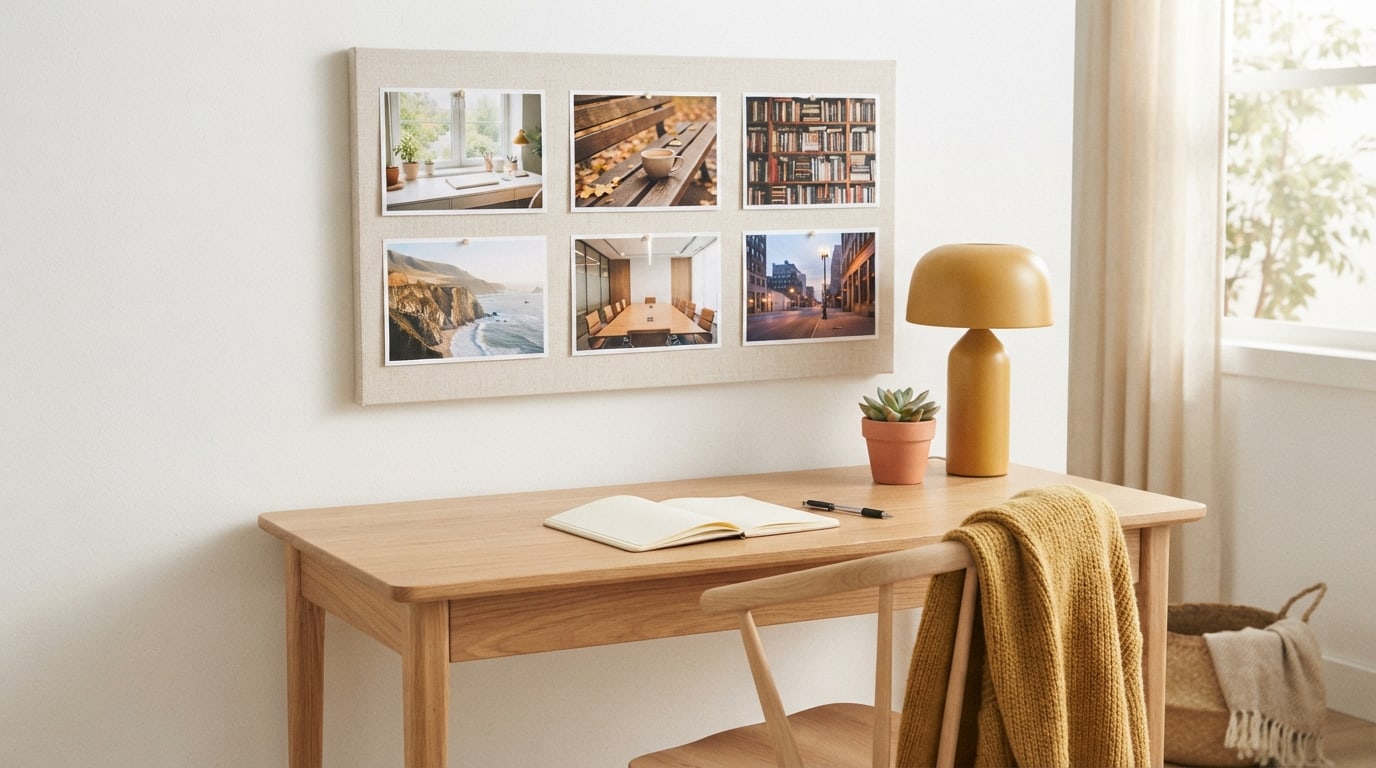
Ideas are useful, but sometimes you need to see a finished board to know what yours could look like. These vision board examples for work cover eight different working lives, from a first job to a return after a break. Each one shows the goals, the images and the first steps, written out in full so you can borrow freely.
Find the example closest to your role, then change every word until it sounds like you.
What makes a good vision board example for work?
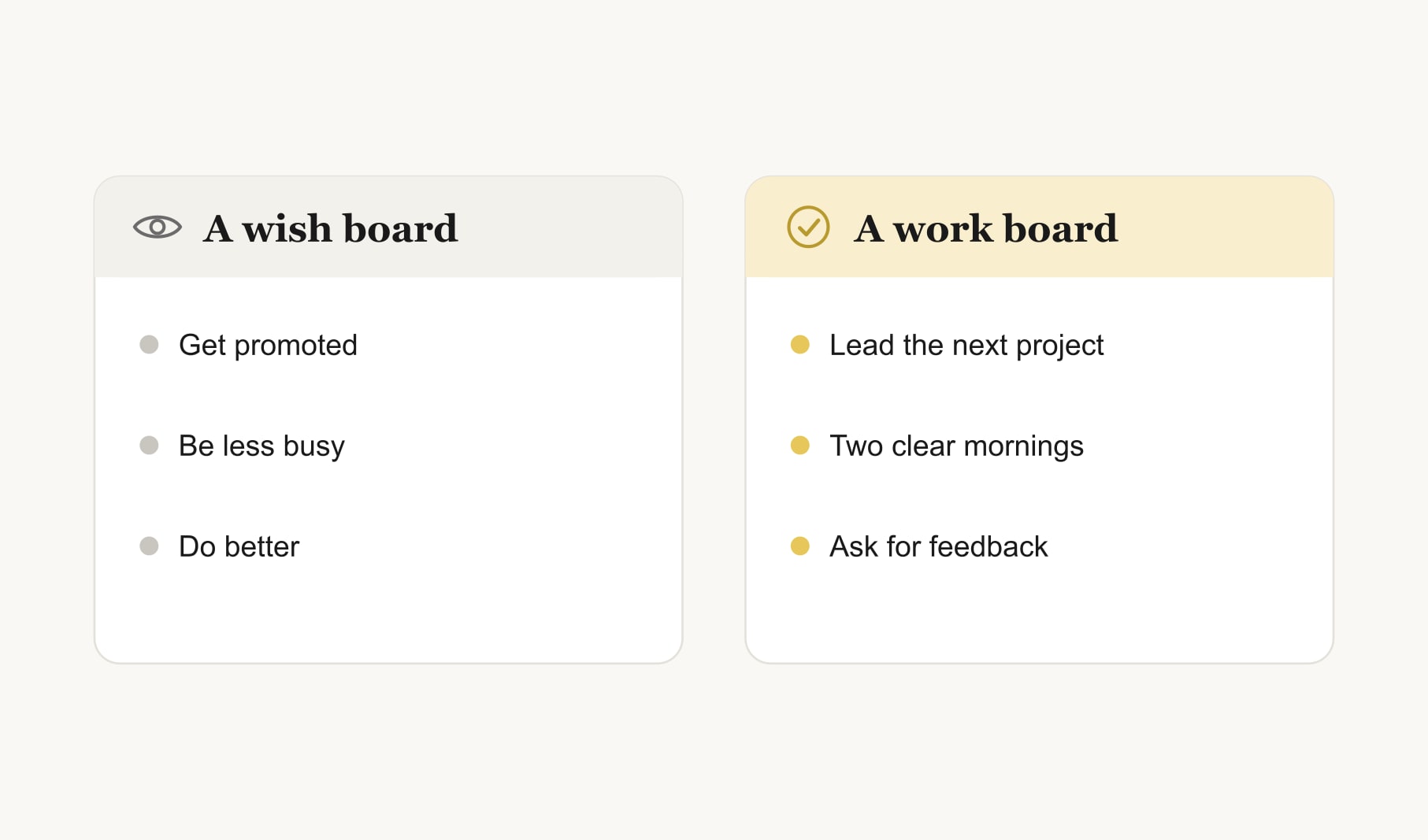
Every example below follows the same pattern. Three to five goals, each within the person’s control. An image for each goal that shows how it will feel. A target date. And a first step small enough to take this week. Notice there are no vague wishes. “Do better at work” never appears. “Two clear mornings a week with no meetings” does.
Example 1: a new graduate in a first job
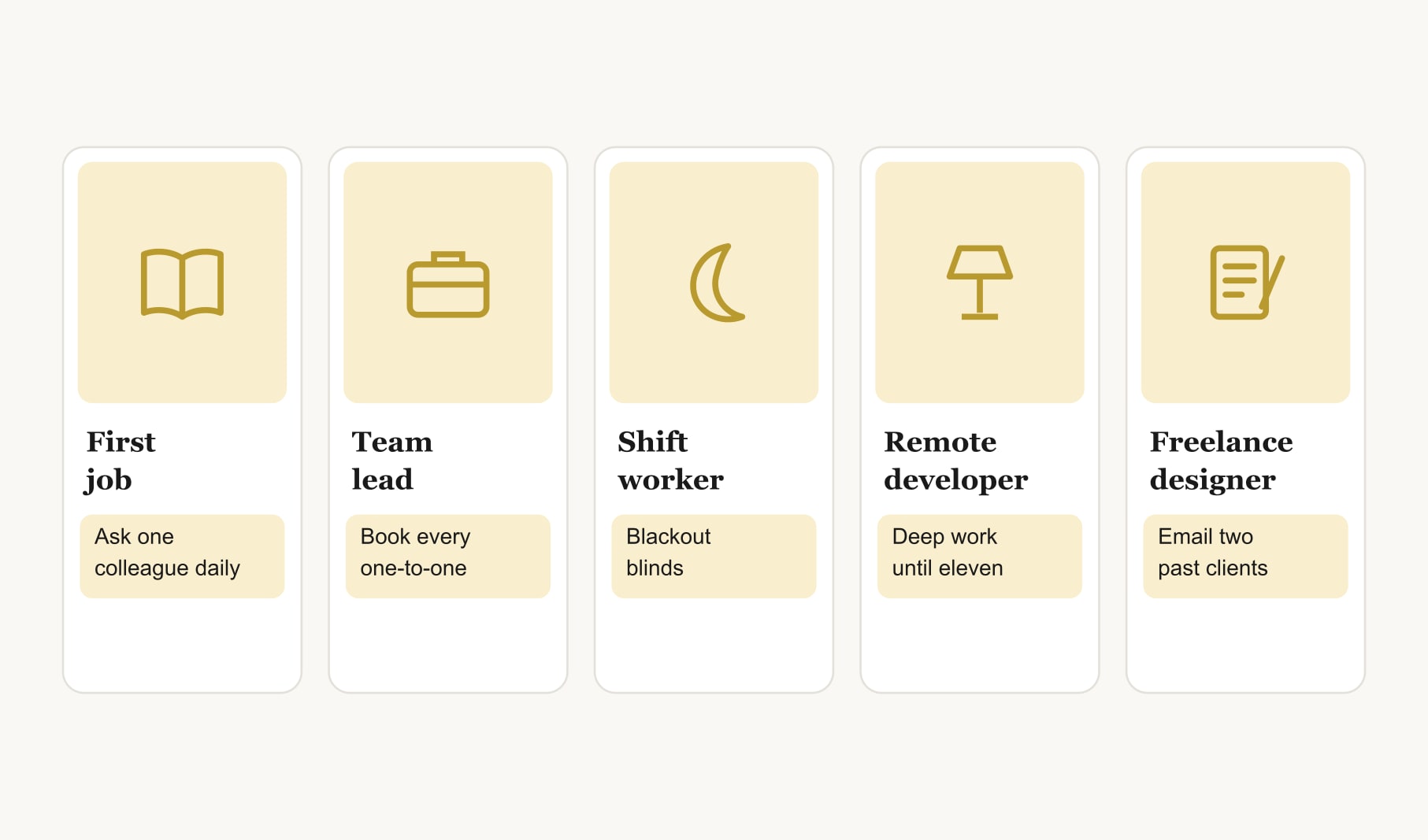
A notebook full of notes: “understand how every part of my team’s work fits together within three months, first step: ask one colleague a day what they work on.” A coffee for two: “three coffees a month with people outside my team, first step: invite one this week.” A finished folder: “deliver my first project on time, first step: break it into weekly pieces.” A park bench: “a proper lunch break every day, first step: put it in the calendar.” For a board built around a fresh start, the new job vision board layout fits this stage well.
Example 2: a new team lead
A table set for two: “a weekly one-to-one with each person, first step: book them all today.” A clear calendar: “a third fewer meetings, first step: decline two recurring ones.” A bookshelf: “learn from a lead I admire, first step: ask for a monthly coffee.” A closed laptop at dusk: “logged off by six on four days, first step: set a gentle alarm.”
Example 3: a teacher
A calm classroom in morning light: “a settled start to every lesson, first step: a two-minute opener for each class.” A neat tray: “marking finished within the school day twice a week, first step: protect my planning periods.” A course book: “complete the middle leadership course, first step: one module this week.” A hillside path: “weekends kept for rest, first step: no school email on Saturdays.”
Example 4: a healthcare shift worker
A dark, calm bedroom: “a steady sleep routine after night shifts, first step: fit blackout blinds.” A packed lunch box: “a proper meal on every shift, first step: batch cook on my first day off.” A certificate frame: “a specialist course this year, first step: ask my manager about funding.” A coastline: “one outing on every block of days off, first step: plan the next one now.”
Example 5: a retail or hospitality supervisor
A welcome pack on a counter: “train two new starters well, first step: write a one-page welcome guide.” A tidy shop floor at closing: “a calmer close every night, first step: a ten-point checklist by the till.” A name badge with no lettering: “move into assistant manager, first step: ask what the role needs.” A Saturday market: “one full weekend off each month, first step: request it on the rota.”
Example 6: a remote software developer
A quiet desk by a window: “two deep work blocks a day, first step: notifications off until eleven.” A whiteboard sketch with no writing: “deliver the feature I proposed, first step: write the outline.” A small stage with an empty microphone stand: “speak at a local meetup, first step: pick a topic.” A pair of trainers by the door: “a walk at noon every day, first step: shoes out the night before.”
Example 7: a freelance designer
A sunny studio table: “three regular clients I love working with, first step: email two past clients this week.” A row of printed layouts: “a refreshed portfolio, first step: choose six projects.” A tidy folder: “invoices sent every Friday, first step: set a weekly reminder.” A sunset over a city: “finish at five most days, first step: an end-of-day ritual of tidying the desk.”
Example 8: returning to work after a break
A fresh notebook: “a refreshed CV, first step: rewrite one section tonight.” A laptop on a kitchen table: “one skill updated, first step: start a short online course.” A café table for two: “three conversations with people in my field, first step: message one this week.” A family calendar: “a routine that fits home life, first step: plan the first week back in detail.”
What do these vision board examples for work have in common?
Three things. Every board includes at least one balance goal, like a lunch break, a finish time or a protected weekend. Every goal is something the person controls, even when it points at something bigger like a promotion. And every first step is tiny, because tiny steps are the ones that happen on a busy Tuesday. A habit tracker for your vision board suits the repeated steps, like a daily walk or a weekly invoice.
How do you turn an example into your own work vision board?
Choose the example closest to your role and keep its structure. Then rewrite every goal using your own job: your calendar, your last review, your energy. Swap the images for photos from your own working life wherever you can. My step-by-step guide on how to make a vision board for work walks through that process, and the vision board examples gallery has ready layouts you can open and fill with your own images.
Review your board once a week in a slot you already have, and rebuild it each quarter. The best example is always the next version of your own.
Keep reading
Vision board examples for work: your questions
A good vision board example for work holds three to five goals tied to a real role, such as protected focus time, a skill to learn, a project to lead and a boundary like logging off on time. Each square carries an image, a target date and a first step.
A work vision board should include goals within your control, an image for each that captures how success will feel, a target date and one first step you can take this week. Many good boards also include a balance square, such as a proper lunch break or a finish time.
Yes. Shift workers often get the most from a work vision board focused on energy and recovery: a sleep routine after night shifts, proper meals, protected days off and one development goal. Keeping the board on a locker door or a phone suits changing rotas well.
A vision board for a new job usually focuses on learning: understanding how the team works, building contacts across the organisation, delivering a first project and setting healthy routines from day one. Each goal gets a date within the first few months and a simple first step.
Three to five goals suits most work vision boards. Fewer goals stay visible and actionable alongside a busy job, while more tend to compete with the daily to-do list. Many people use three: one for focus, one for growth and one for balance.
A freelancer can benefit greatly from a vision board for work, because no manager is setting direction. Useful squares include the kind of clients to attract, a portfolio refresh, a skill course, a regular invoicing habit and a set finish time to protect evenings.
Pick the example closest to your role, keep the structure of image, goal, date and first step, and rewrite every goal in your own words. Swap images for photos from your own working life where possible, so the vision board reflects your job rather than someone else’s.
Keep your vision board alive
A board built in your browser resets when you close the tab. Vision Boardly saves your boards, reminds you as each vision date arrives, and tracks the habits and moods moving you toward them.
Get Vision Boardly Free