How to Create a Career Vision Board
A career board looks years ahead, so it needs more than a few pictures. Here is how to build one with a direction, a timeline and a first step.
To create a career vision board, look back at the work that energised you, name your values and strengths, and choose a direction three to five years out. Map milestones on a timeline, add the skills and people you need, pick an image for each milestone, and give the nearest one a first step.

A career is longer than a job, so a career vision board has to look further ahead than a work board does. Learning how to create a career vision board is really learning to do three things at once: choose a direction, break it into milestones, and keep the nearest milestone small enough to start this week.
Give yourself about ninety minutes and a notebook. If you want ideas to draw on, my list of vision board ideas for career growth is a good companion. Here, we build.
Step 1: What should you look back on first?
Before you look forward, look back. List every role, project or study period you have had, and mark each one: did it give you energy or drain it? Note the specific moments you loved, like solving a hard problem, teaching someone or making something with your hands. Patterns appear quickly, and they are better guides than any job title.
Step 2: How do you name your values and strengths?
From that list, pick three values your best moments share, such as independence, craft, service or variety. Then pick three strengths other people come to you for. Write them at the top of your page. Every milestone on the board should fit at least one value and use at least one strength.
Step 3: How far ahead should a career direction look?
Three to five years works for most people. It is far enough to allow real change and near enough to plan for. Write your direction as one sentence: “leading a small design team at a company whose work I believe in,” or “running my own landscaping business with two staff.” A direction is not a promise. It is a heading you can adjust.
If you want help with the thinking behind this step, my set of career vision board questions walks through it one question at a time.
Step 4: How do you map career milestones on a timeline?
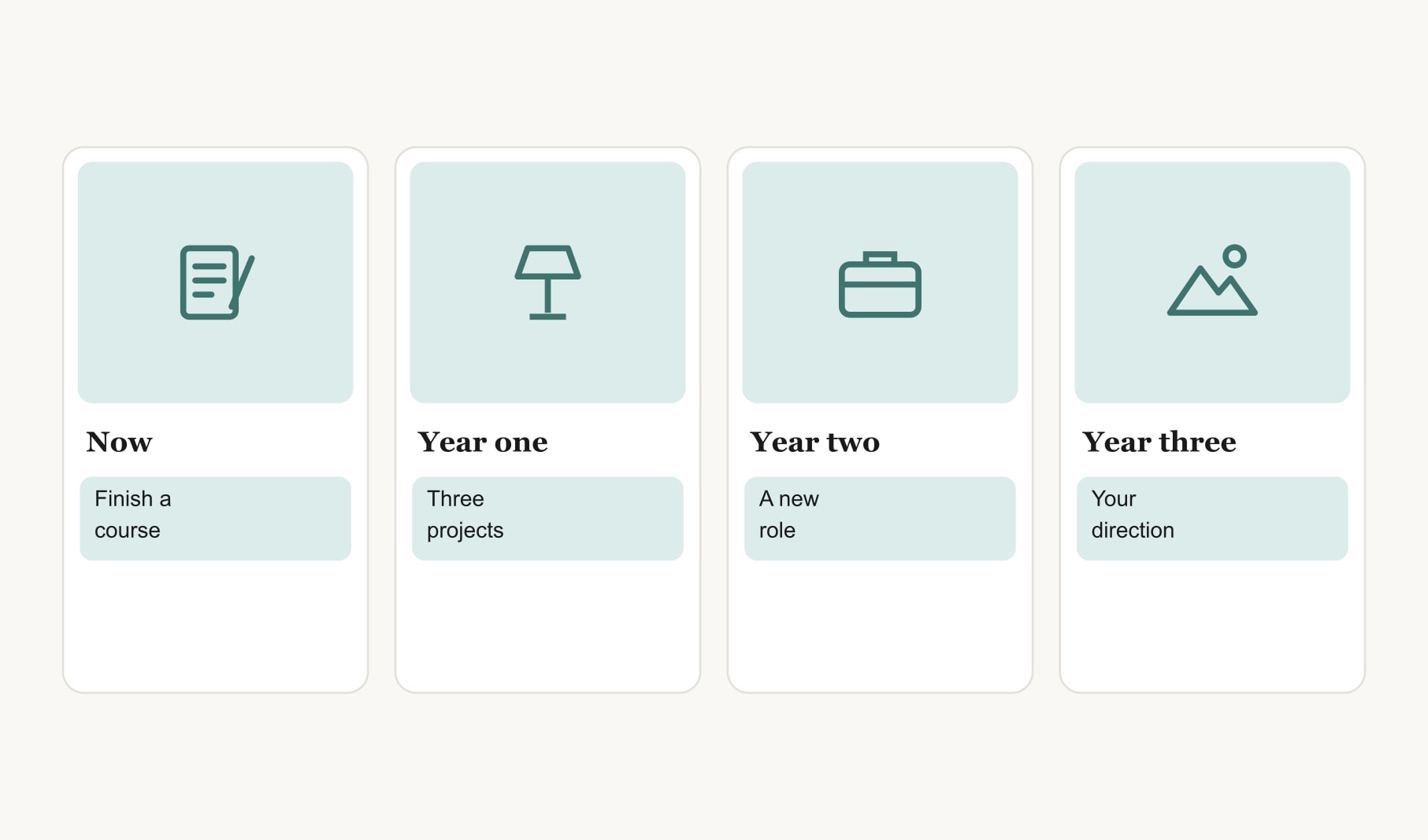
Lay your board out as a timeline rather than a grid. Draw columns for now, year one, year two and year three or beyond. Place your direction at the far right. Then work backwards: what has to be true a year before that, and a year before that? Each answer is a milestone. The vision board and career timeline builder gives you this layout ready to fill.
Step 5: Which skills belong on a career vision board?
For each milestone, ask what you would need to know or be able to do. List the gaps: a qualification, a technical skill, managing people, public speaking or a portfolio. Give the most important gaps their own small squares beneath the timeline, each with a course, a book or a project that will close it.
Step 6: Who can help you along the way?
Careers move through people. Add a row for them: a mentor a few steps ahead, peers in your field, someone who already does the work you are aiming for, and people you can help in return. Picture them as places rather than faces, like a café table or a conference hall, and write one name or role under each.
Step 7: What images suit a career vision board?
Choose one image per milestone that shows the work itself, not the reward. A team gathered round a table for leadership. A finished garden for a landscaping business. A lecture hall for teaching. Your own photos from moments you loved at work are especially strong, because they remind you that the direction is built from real experience.
Step 8: How do you add first steps and review dates?
Only the nearest milestone needs a detailed first step. Make it small and dated: “ask my manager about leading the next project, at our one-to-one on Thursday.” Later milestones keep a rough season. Then set review dates: a short check each month, and a full review every six months, when you move the timeline along, update skills and check that the direction still fits. A goal tracker for your vision board keeps the monthly checks quick.
What does a finished career timeline look like?
Here is an example for someone moving from a support role into product design. Now: “finish a design course, first step: enrol this month,” with an image of a sketchbook. Year one: “three portfolio projects, first step: redesign one internal tool,” with a laptop on a sunny desk. Year two: “a junior designer role,” with a design studio. Year three: “lead design on a product I care about,” with a team round a table. Beneath them sit a skills row and a people row. The direction sits at the far right, and the first step sits at the far left, small enough to do this week.
How is a career vision board different from a work vision board?
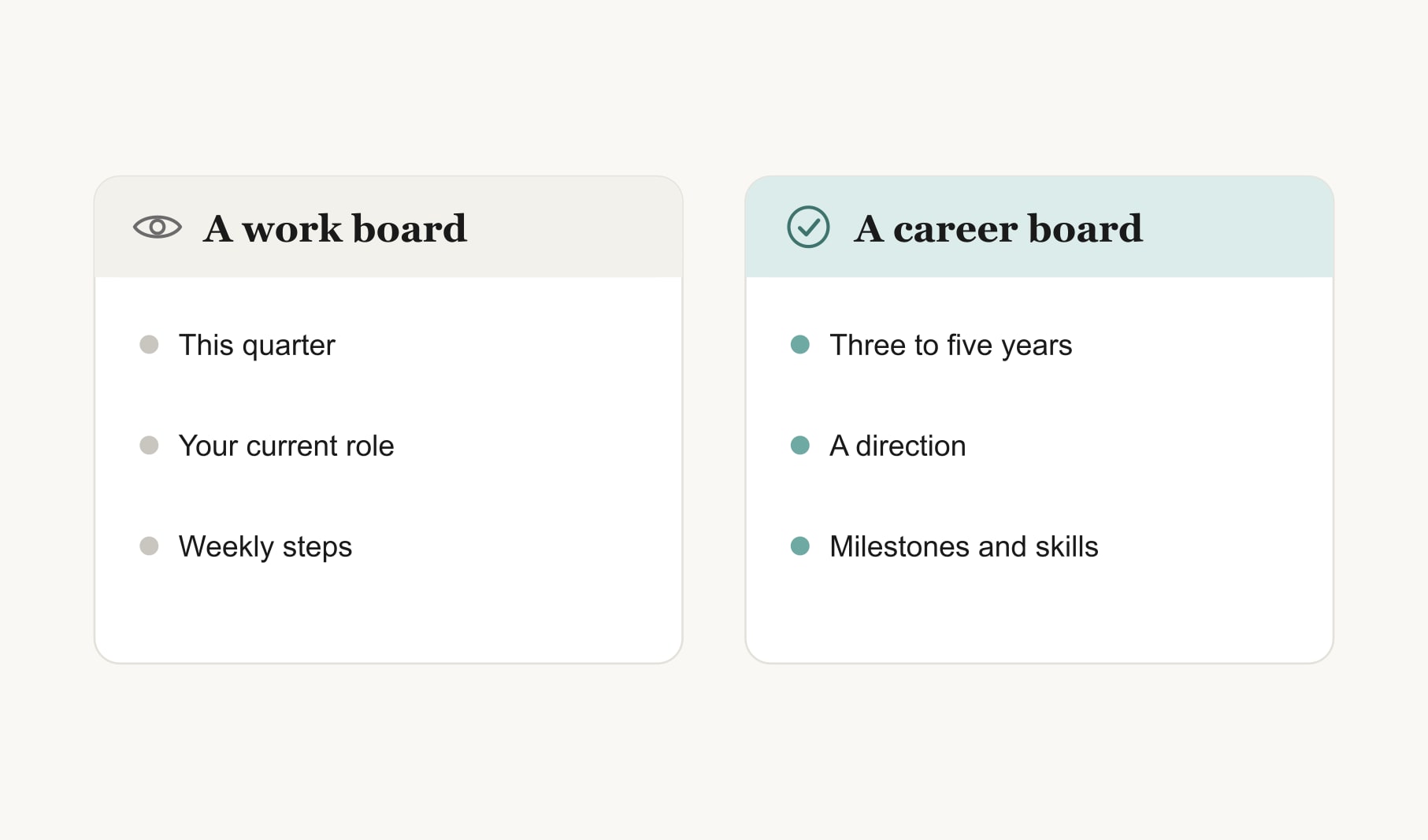
A work board improves the job you have this quarter. A career board points at where your working life is heading over years. Many people keep both: a small work board on the desk, and a career board at home that they review every six months. If you want the shorter version, my guide on how to make a vision board for work covers it step by step.
What if your career direction changes?
It probably will, and that is a sign the board is working. Each review teaches you something: a course you loved, a role that turned out to be dull, a person who opened a new door. When the direction shifts, move it, keep the milestones that still fit and replace the rest. Keep your old boards too. Laid side by side, they tell the story of a career you shaped on purpose.
Keep reading
How to create a career vision board: your questions
Look back at work that energised you, name your values and strengths, and choose a direction three to five years ahead. Map milestones on a timeline, add the skills and people you need, choose an image per milestone and give the nearest milestone a dated first step. Review the career vision board monthly.
A career vision board should hold a clear direction, three or four milestones on a timeline, the skills you need to build, the people who can help and one image per milestone. The nearest milestone carries a dated first step, so the board always shows what to do next.
Three to five years suits most career vision boards. It is long enough for real change, like a new field or a leadership role, and short enough to plan milestones you can picture. Review the direction every six months, because careers and interests shift over time.
Yes. A career vision board suits a career change well, because it maps the bridge between your current role and the new field: courses, portfolio work, conversations and a first role in the new area. Breaking the change into dated milestones makes it feel achievable.
Pay goals can sit on a career vision board if they motivate you, but pair them with what you would do to earn it, such as a skill or a role. These are planning ideas rather than financial advice. Keep the vision board focused on the work itself, not only the reward.
Check a career vision board briefly each month to confirm the nearest first step is moving. Every six months, do a full review: move the timeline along, update skills and people, and ask whether the direction still fits your values and strengths.
A timeline layout works best for most career vision boards, with columns for now, year one, year two and year three or beyond. The direction sits on the far right, the first step on the far left, and rows for skills and people run underneath the milestones.
Keep your vision board alive
A board built in your browser resets when you close the tab. Vision Boardly saves your boards, reminds you as each vision date arrives, and tracks the habits and moods moving you toward them.
Get Vision Boardly Free