How to Make a Vision Board
How to Make a Vision Board
Pick a few life areas, give every image a date and a first step, then look at it every week. That is the whole method, and I will walk you through it.
To make a vision board, choose three to five life areas, write one clear goal for each, and find an image that makes that goal feel real. Arrange the images on a board, add a target date and a first step to each, then put it somewhere you look every day.
I have made more vision boards than I can count, and my honest confession is that the first few did nothing. They were pretty. They were also a pile of magazine pages I stopped noticing within a week. So when you ask me how to make a vision board, I am not going to tell you to cut out pictures and hope. I am going to show you how to make one you will actually use.
Here is the short version. A good vision board is small, specific and dated. Every picture on it stands for one thing you want, by a certain time, with one next step you can take this week. Everything below is how to get there.
What do you need before you make a vision board?
Less than you think. Learning how to make a vision board takes an hour and a few basics, not a shopping trip. You need a surface, some images and about an hour where nobody needs you. The surface can be a cork board, a sheet of card, a page in a notebook or a screen. Paper boards are lovely because you pass them every day. Digital boards are easier to edit and they come with you on your phone. Pick whichever one you will actually see.
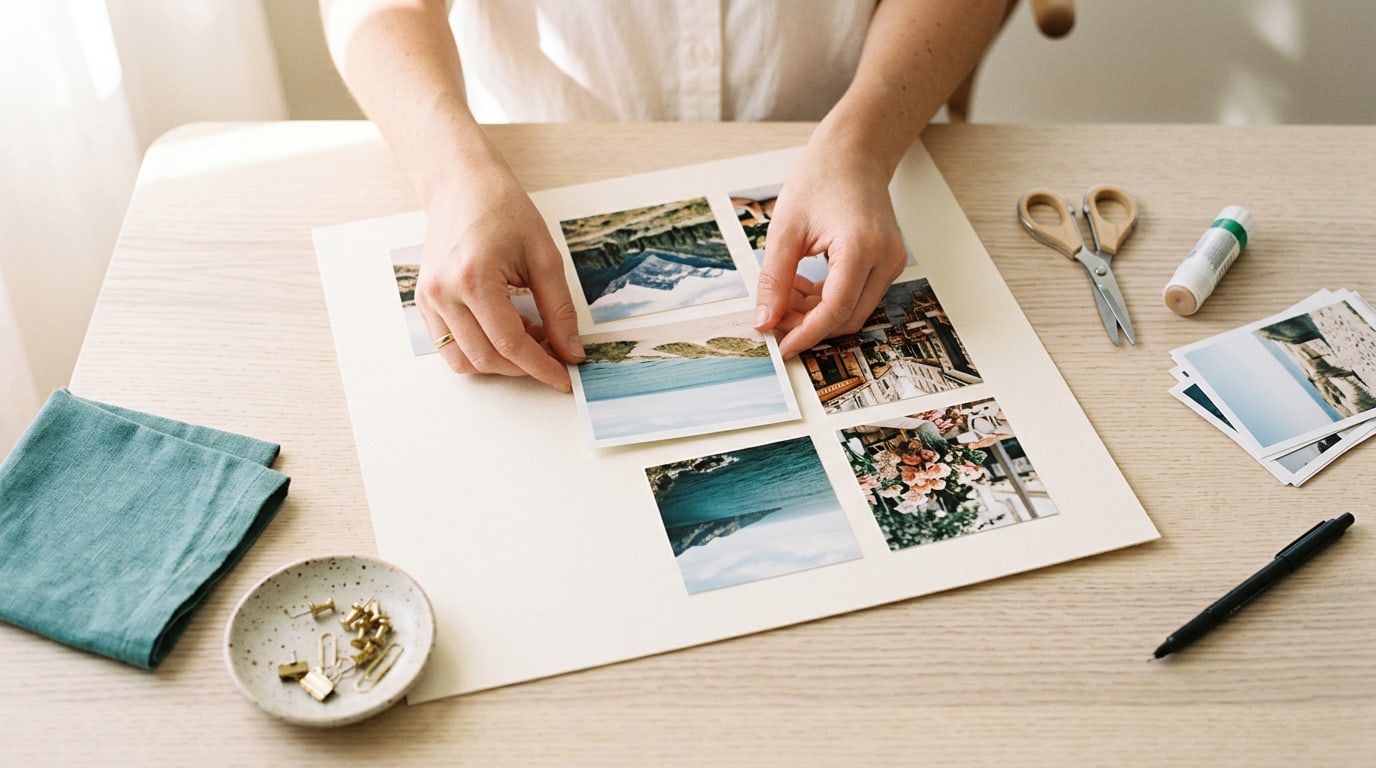
For images, use magazines, printed photos, your own camera roll or free stock photo sites. Add a pen, plus scissors and glue or pins if you are going physical. That is the full supply list. You do not need a special kit, and please do not let shopping for one become the thing that stops you starting.
Want to know how to make a vision board, step by step?
1. Pick three to five life areas
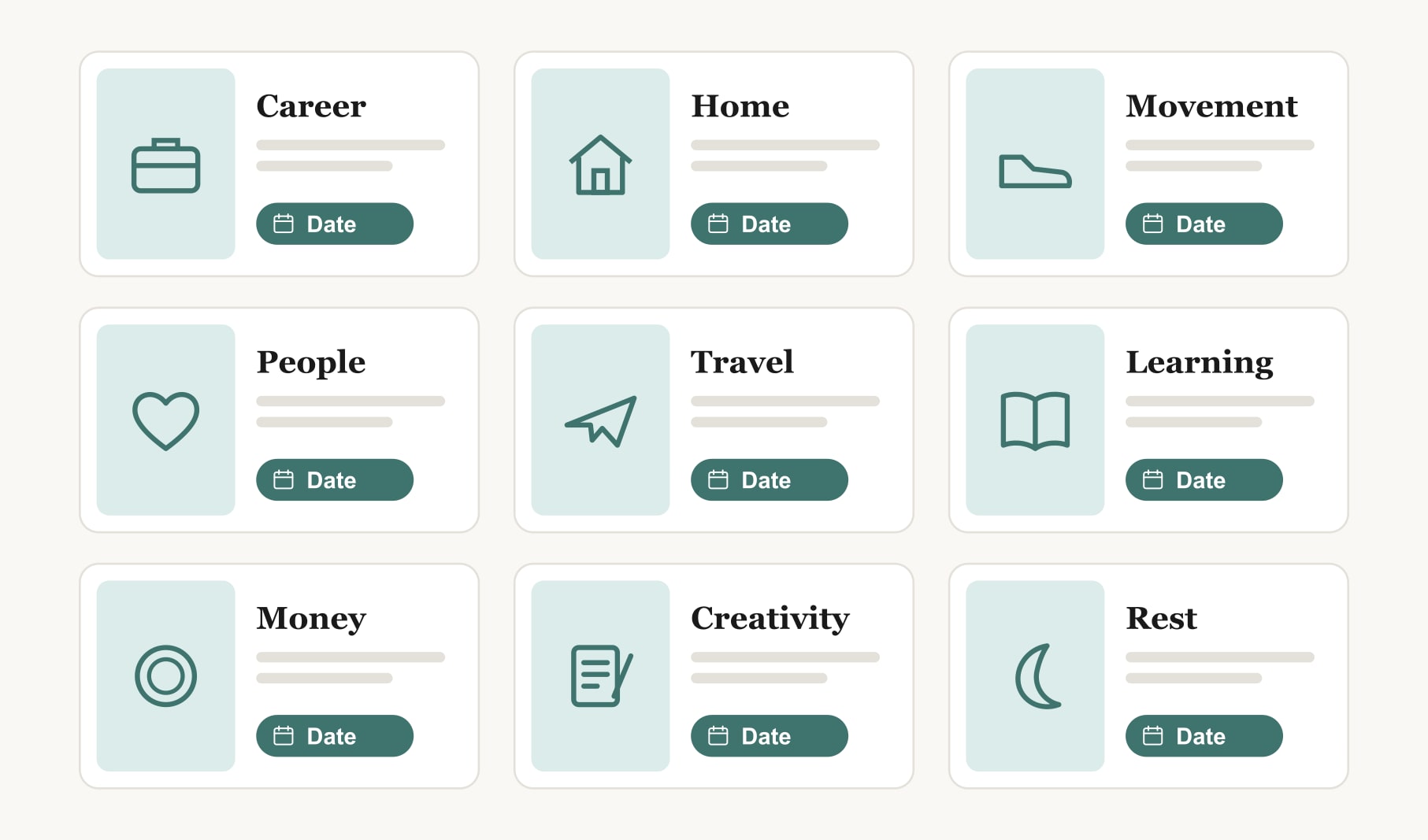
Start with the parts of your life you most want to grow. Career, home, health, relationships, money, travel, learning, creativity and rest are the usual ones. Nine is the most I would ever put on one board, and three to five is where most people do their best work. If everything is a priority, nothing on the board gets your attention. If you are stuck, my list of vision board ideas by life area will get you moving.
2. Write one clear goal for each area
Before you touch a single picture, write one sentence per area. Not “be healthier” but “walk for thirty minutes, four mornings a week.” Not “travel more” but “spend a week in Lisbon.” Specific goals are easier to picture and far easier to act on. This is the step most people skip, and it is the one that makes everything else work.
3. Find images that make each goal feel real
Now go hunting. You want images that give you a small jolt of “yes, that one” when you see them. A photo of the exact kind of kitchen you want beats a generic mansion every time. Your own photos are powerful too: the view from a walk you loved, or a picture of you at your happiest. If you want words alongside the pictures, a short phrase or a vision board quote that sounds like you works well. Keep it to a few words so the board stays easy to read at a glance.
4. Lay it out before you stick anything down
Arrange everything loosely first. I like a simple grid, one vision per square, because I can see at a glance what is there and what is missing. A collage looks more artistic, which is great if that is your style, but give each goal its own clear spot so nothing gets buried. Leave a little white space too. A crowded board is a board your eyes skip over.
5. Give every vision a date and a first step
This is my one non-negotiable. Under each image, write a target date and the very first action you will take. “A week in Lisbon, by next spring. First step: open a travel savings pot this Friday.” A date turns a wish into a plan. A first step means you know exactly what to do on a flat Tuesday afternoon when the motivation has gone quiet.
There is real research behind this. Psychologists call it an implementation intention: a plan that says when, where and how you will act. People who make these if-then plans tend to follow through more often than people who only set the goal. And work by the psychologist Gabriele Oettingen suggests that daydreaming about the finished result on its own can drain the energy you need to chase it. The picture gets you excited. The plan gets you moving.
6. Put your vision board where you will see it every day
A vision board in a drawer is a scrapbook. Put yours where your eyes land without effort: next to the mirror, above your desk, or on your phone lock screen if you went digital. I keep mine where I drink my first coffee, because that is the one minute of the day I reliably sit still. Whether that glance is a moment of prayer, an intention for the day or a quick planning check, the habit is what matters.
7. Check in once a week
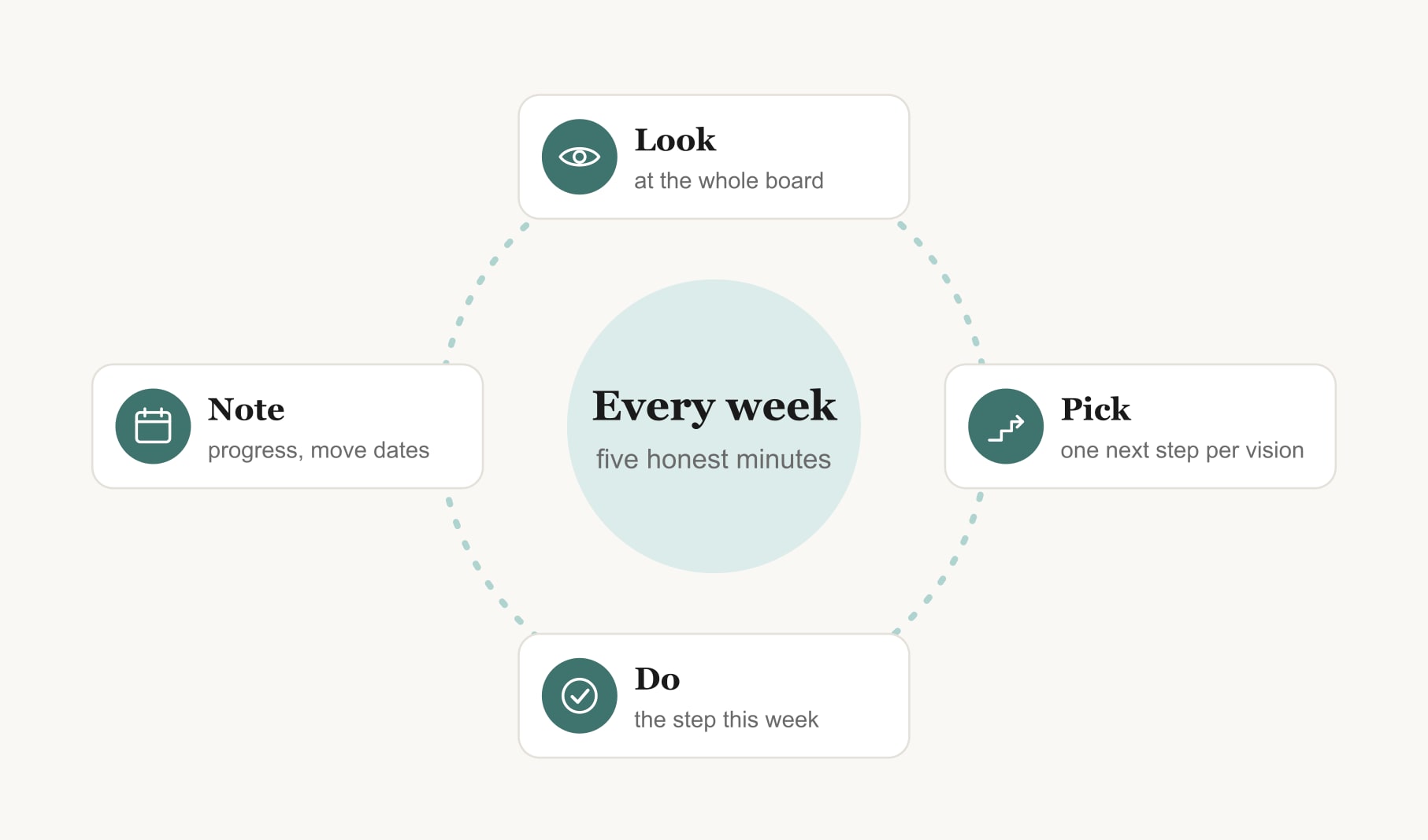
Once a week, give your board five honest minutes. Which vision moved forward? Which date needs to shift? What is the next small step for each one? Tick off progress, swap out images that no longer excite you and celebrate anything you finished. A simple goal tracker for your vision board makes this quicker, because you see every goal and its progress in one place.
What are the most common vision board mistakes?
I have made every one of these, so no judgement here. The first is too many goals. Twenty pictures means twenty things fighting for your attention, and you end up acting on none of them. The second is images with no meaning, the ones you picked because they looked nice rather than because they stand for something you want.
The third is making the board and never looking at it again. The fourth is treating the board like a lottery ticket. A vision board keeps your goals in front of you and helps you notice chances to act. It does not do the acting for you, and honestly, that is good news. It means the outcome stays in your hands.
Should you make a paper or a digital vision board?
Both work, and how to make a vision board is the same either way. Paper is tactile and sits in your space all day, which is a real advantage. Digital is easier to update, and it travels with you. If you want to try the screen route, here is how to make a digital vision board from scratch. If paper calls to you, fill in a printable vision board template and pin it up the old way. My honest take: start with whichever feels easier today. You can always make the other one later.
How often should you update your vision board?
Refresh it whenever a vision is done or no longer feels like yours. Plenty of people rebuild the whole board once a year, often around a birthday or the new year, and that is a lovely ritual. Just do not wait a full year to touch it. A vision board is a working document, not a museum piece.
So that is how to make a vision board the way I actually do it: fewer goals, real images, a date and a first step under every one, and a weekly look. Make yours this week, keep it where you will see it, and let it nudge you forward.
Keep reading
How to make a vision board: your questions
Once you know how to make a vision board, most people finish one in one to two hours. Writing your goals takes about twenty minutes, finding images usually takes the longest, and arranging everything and adding dates takes around half an hour. Splitting the work across two sittings is fine and often leads to clearer choices.
Three to five goals is the sweet spot for most vision boards, and nine is a sensible maximum. Fewer goals means each one gets real attention and a real first step. If you have more than that, start a second board for later or rotate new goals in as others finish.
Besides pictures, a vision board works well with a target date and a first step under each image, a few short words or quotes, and a brief note on why each goal matters to you. Keep any text short, so the board stays readable in the few seconds you glance at it.
Hang your vision board somewhere you look every day without trying, such as beside a mirror, above a desk or near the spot where you have your morning drink. For a digital vision board, a phone lock screen or desktop background works well. Daily visibility matters more than the exact spot.
A vision board works best as a focus tool rather than a shortcut. Research on goal setting suggests that specific goals and if-then plans improve follow-through, while picturing the outcome alone can sap motivation. Pair every image with a date and a first action, and your board supports real progress.
Any moment you want a fresh start is a good time to make a vision board. The new year, a birthday, a move or a new job are popular moments, but an ordinary Sunday afternoon works just as well. What matters most is making the board and then looking at it every week.
Yes, you can make a vision board without any craft supplies. Use a notebook page and a pen, printed photos and tape, or build a digital vision board on your phone or computer. Your goals, images and dates matter far more than scissors, glue or a special kit ever will.
Keep your vision board alive
A board built in your browser resets when you close the tab. Vision Boardly saves your boards, reminds you as each vision date arrives, and tracks the habits and moods moving you toward them.
Get Vision Boardly Free