
Money Vision Board Quotes
Calm, sourced lines about spending, saving and enough, each paired with a small habit you can start this week.
The best money vision board quotes are calm lines about values and habits, not riches. Try Emerson’s "Money often costs too much", Franklin’s "Waste nothing" or Micawber’s "result happiness" from David Copperfield. Place one beside each money goal and write a small weekly habit underneath, such as a Sunday balance check.

Money is the goal people feel shyest about putting on a board, so the words beside it matter. The best money vision board quotes do not shout about riches. They help you feel calm, clear and in charge of the choices you make with what you have. Every quote below has a source I checked line by line on Wikiquote, and I have added a few lines of my own that you are welcome to borrow.
What makes good money vision board quotes?
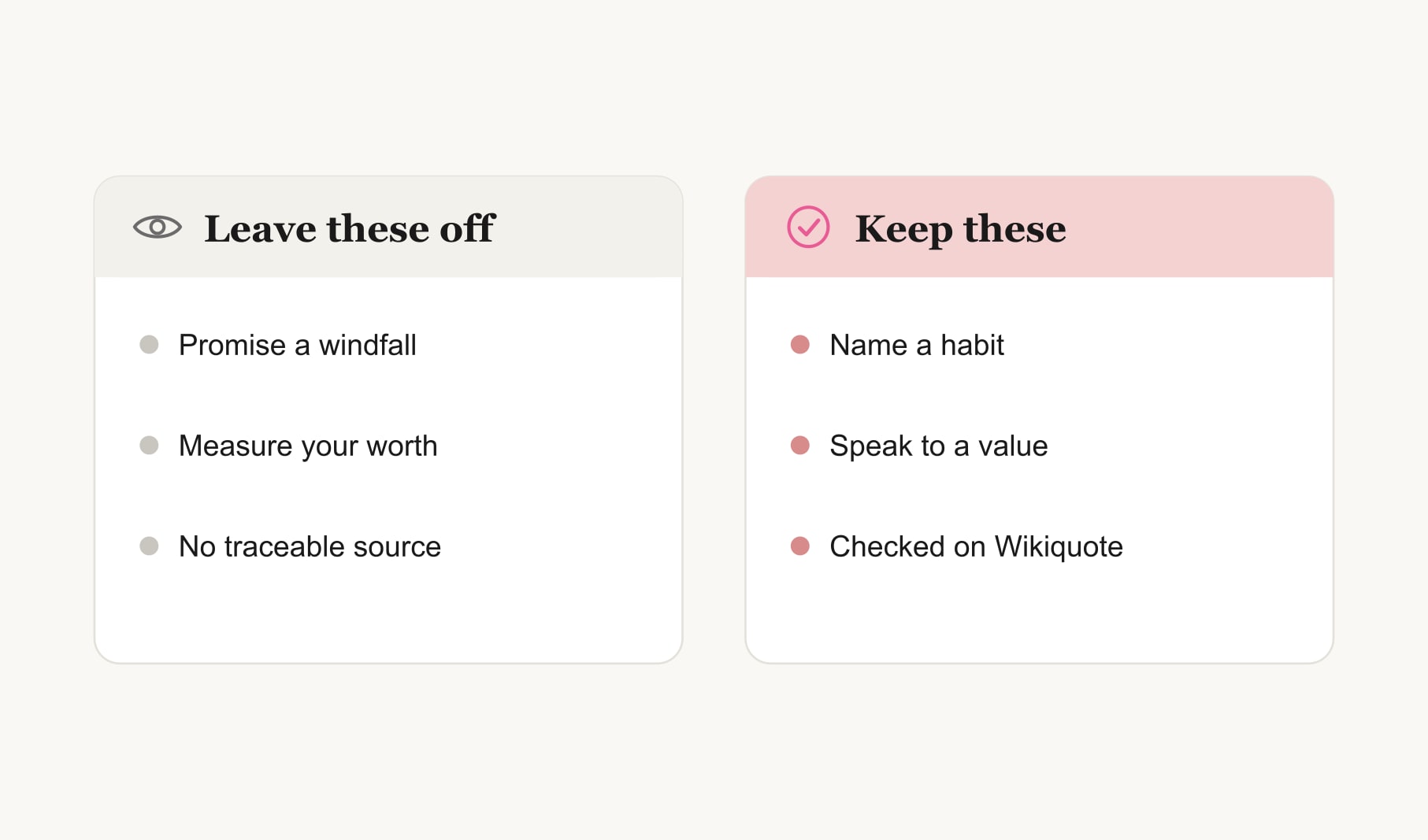
I look for three things. First, the line talks about choices and values rather than amounts. Second, it is calm. A money quote that makes your chest tighten will not survive a month on your wall. Third, it pairs with a habit you can actually do this week, like checking your balance on a Sunday or moving a small amount into savings on payday.
If a line promises sudden wealth, I leave it off. Those lines tend to leave people feeling behind rather than motivated, and they rarely have a real source anyway.
Which money quotes have a checked source?
These four come from published works, and each one does a different job on a board.
- “Money often costs too much.” Ralph Waldo Emerson, The Conduct of Life, from the essay “Wealth”. Five words that ask whether a purchase is worth the hours behind it. I put this one beside any goal about spending less on things and more on time.
- “Make no Expense but to do good to others or yourself; i.e. Waste nothing.” Benjamin Franklin, from the Autobiography, where it is the fifth of thirteen virtues, Frugality. I love it because it gives spending a purpose test rather than a ban.
- “Annual income twenty pounds, annual expenditure nineteen nineteen and six, result happiness.” Mr. Micawber in Charles Dickens’s David Copperfield, chapter 12. The whole idea of a budget in one sentence: spend a little less than comes in. It makes people smile, which helps.
- “Neither a borrower nor a lender be.” Polonius in William Shakespeare’s Hamlet, Act I, Scene iii. Short and memorable. It suits a goal to clear one balance, though Polonius is a fussy adviser in the play, so hold it lightly.
You can read the full Micawber passage, with its gloomier second half, on Wikiquote’s David Copperfield page. It is a good habit to look up any money quote there before it goes on your wall.
How do you pair a money quote with a goal?
Give every quote a job. Put Franklin beside a savings goal and write the habit underneath: “move a set amount on payday.” Put Emerson beside a goal about time, such as fewer late shifts or a long weekend with people you love. Put Micawber beside your monthly budget, with the one number that matters to you written small below it.
If money is the main theme this year, build the whole thing on a money vision board, so every square holds one goal, one image and one date. My guide to vision board financial goals walks through turning a vague wish into a specific, dated step.
Can you write your own money vision board quotes?
Yes, and your own lines often land harder than famous ones because they describe your life. Write them as calm statements of a habit or a value, not a wish for a sum. Here are some of mine, free to borrow:
- Every coin has a job.
- Calm money, clear plans.
- Small amounts, often.
- I spend on what I value.
- Enough is a number I choose.
- Saved on purpose.
Read yours aloud. If it sounds like something you could say to a friend without wincing, keep it. If you want help phrasing lines in the present tense, the affirmation generator is a quick way to draft a few options and pick the one that fits.
Where should money quotes sit on the board?
Right beside the money goal they support, not floating at the top. Keep it to one or two money lines per board. More than that and the board starts to feel like a spreadsheet. Pick an image that shows what the money is for: a front door, a quiet desk, a train ticket. The quote explains the choice, and the picture shows the reward.
Which money lines should you leave off?
Anything that measures your worth in money, anything that promises a windfall, and anything that makes you feel ashamed of where you are now. Also skip lines you cannot trace to a real source. Many viral money quotes carry a famous name with no book, speech or letter behind them.
A gentle test: read the line on the day before payday, when funds feel tight. If it steadies you, it belongs. If it stings, swap it.
What does a money board with quotes look like?
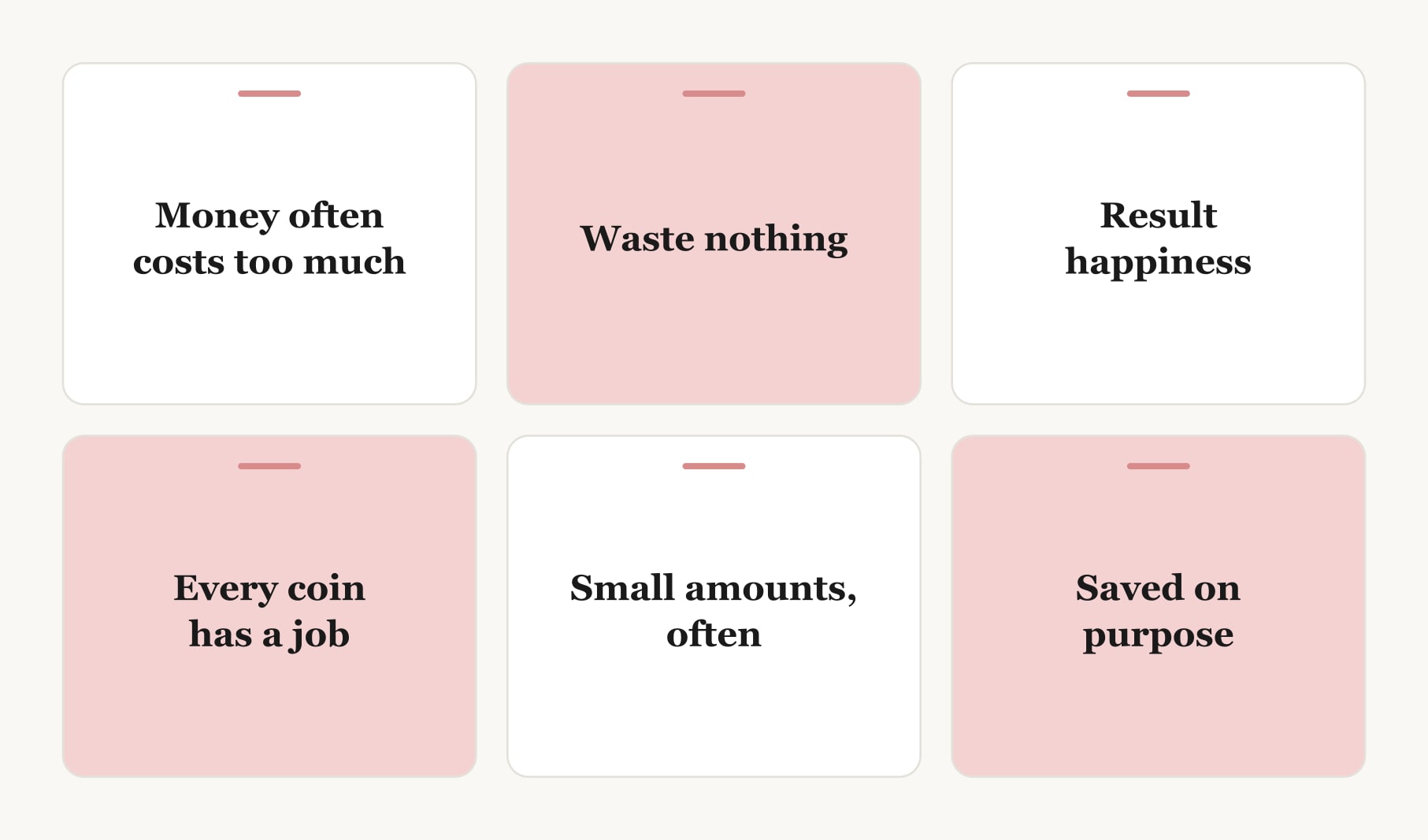
Picture six squares. A sunny front door, with Franklin’s line beneath it and a monthly savings habit. A calm desk for clearing one card balance, with “Every coin has a job.” A train platform for a trip paid in full, with “Small amounts, often.” A long table for more evenings at home, with “Money often costs too much.” Two plain squares hold the dates and a weekly check-in. Four lines, each with a job, and the board still breathes.
How do you keep money quotes working?
Pair each line with a tiny repeating action and track it. A weekly money check, ten minutes on a Sunday, is a habit worth logging in a habit tracker for your vision board. Each tick under the quote turns words into proof that you are following through.
Then refresh. When a goal is reached, retire its quote, celebrate, and choose a new line for the next goal. Over a year, your money vision board quotes become a small record of the choices that got you there.
Keep reading
Money vision board quotes: your questions
Good money vision board quotes are calm lines about values and habits rather than riches. Emerson’s "Money often costs too much" and Franklin’s "Waste nothing" are short and sourced. Your own present tense lines, such as "every coin has a job", work just as well beside a money goal.
Place each money quote right beside the money goal it supports, next to an image of what the money is for, such as a front door or a train ticket. Write the matching habit underneath. Keep money lines to one or two per vision board so it stays calm.
Yes. Write a short present tense line about a habit or a value, such as "small amounts, often" or "I spend on what I value". Read it aloud. If it steadies you, it belongs on your vision board. If it sounds like pressure, rewrite it until it sounds like you.
Money quotes feel stressful when they measure your worth in money, promise a windfall or compare you with others. Those lines highlight the gap instead of the next step. Swap them for vision board lines that name a habit or a value, and the board starts to steady you.
Search the exact wording on Wikiquote and see which section it sits in. Lines under a sourced heading come with a book, letter or speech. Lines marked disputed or misattributed should go on your vision board without the famous name, or not at all.
Change a money quote when its goal is reached or when you stop noticing it. Many people refresh their vision board lines every few months. Keep retired quotes in a notebook, because rereading them later shows the choices and habits that carried each money goal forward.
Keep your vision board alive
A board built in your browser resets when you close the tab. Vision Boardly saves your boards, reminds you as each vision date arrives, and tracks the habits and moods moving you toward them.
Get Vision Boardly Free