
Do Vision Boards Really Work
The evidence supports a board’s ingredients more than the board itself. Here is how to read that honestly, and build on what holds up.
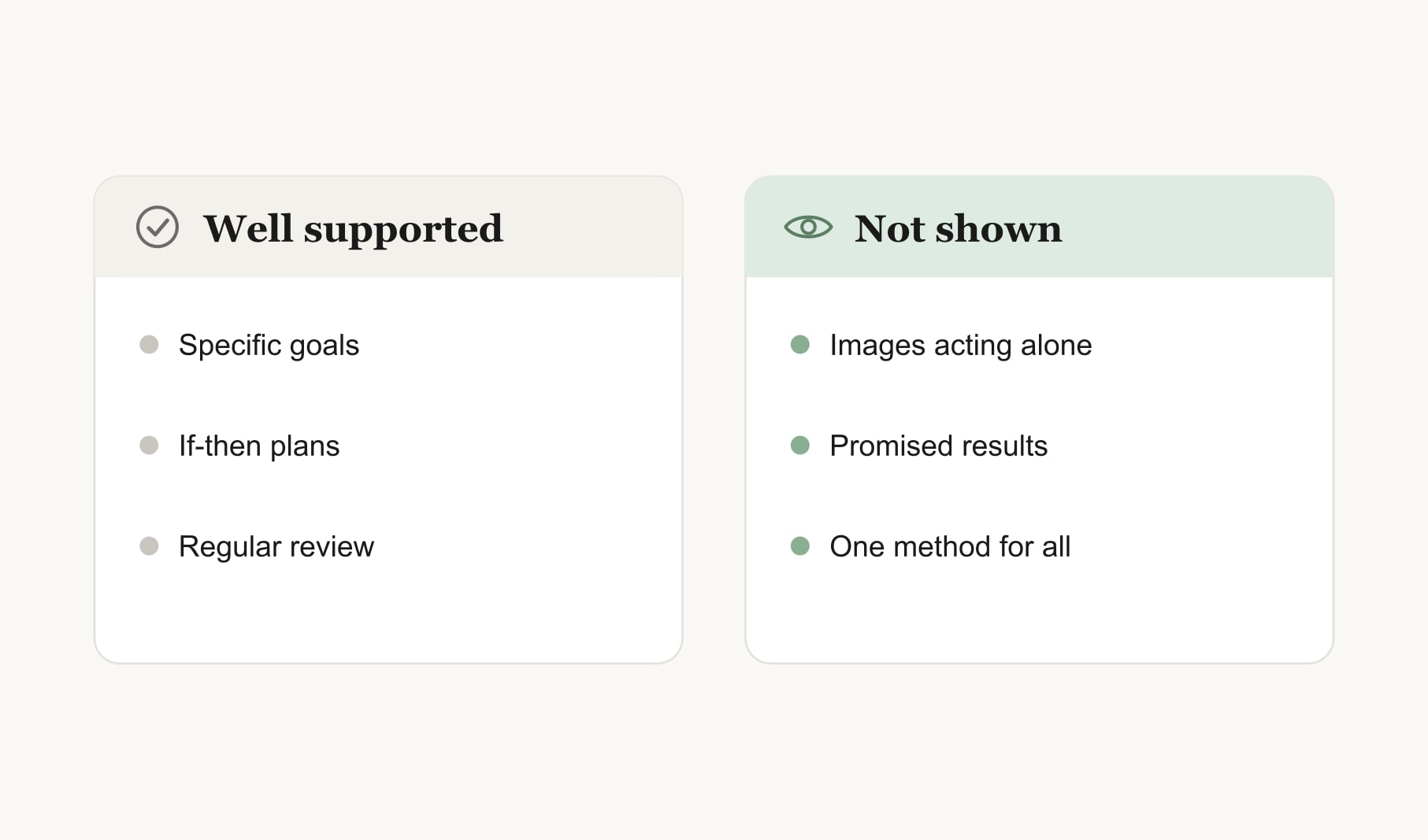
Vision boards really work best as a carrier for well-supported habits: specific goals, if-then plans and regular review. Research backs those ingredients more than boards themselves, and some bold claims about images steering behaviour unconsciously have not held up. Build your board on the supported parts and judge it by your actions.

Do vision boards really work, according to the research? The honest answer has two halves: what the evidence can tell you, and what it cannot. Most articles only give you the flattering half. I think you deserve both, because knowing the limits is exactly what lets you build a board that stands on solid ground.
What has research actually looked at?
Mostly the ingredients, not the finished board. There is a large body of work on goal setting, on plans that say when and where you will act, on mental imagery in sport and on what happens when people only daydream about success. I have covered those findings in my summary of what the goal research says about vision boards, so I will not repeat them here.
What I have not found is a large, well-controlled study that tests vision boards themselves, for example by comparing people who make a board with people who write the same goals as a list. That gap matters, and it is worth being clear about.
Do vision boards really work, or do their ingredients?
Think of baking. Knowing that flour, eggs and butter are good ingredients does not tell you whether a particular cake turned out well. In the same way, knowing that specific goals and if-then plans help people follow through does not prove that a collage on a wall helps. It suggests a board built around those ingredients is likely to help, because it carries them into your day.
That is a reasonable conclusion, and it is also more modest than “vision boards are proven.” I would rather give you the modest version you can trust.
What can the research not tell you?
Three things, mainly. First, whether a picture on a wall adds anything beyond a well-written plan. It may, through attention and feeling, but that has not been settled. Second, whether images do anything without action. I know of no good evidence that a picture on its own changes outcomes. Third, whether a board will work for you in particular. Research describes averages across groups, and you are one person with your own habits and circumstances.
Why should you be careful with bold claims?
You will often read that looking at goal images “programs your subconscious” so that you pursue goals without trying. Be cautious. Psychology went through a period now called the replication crisis, when other labs tried to repeat well-known findings and many did not hold up. Some studies on goal priming, the idea that brief glimpses of achievement cues nudge behaviour without awareness, were among those that failed to replicate.
That does not mean images do nothing. It means the dramatic version of the story rests on shaky ground, while the plain version, that a visible plan helps you remember to act, rests on firmer footing.
How do you read a claim about vision boards?
Ask three quick questions. Is the claim about vision boards, or about an ingredient such as goal setting? Did anyone compare people who used a board with people who did not? And does the claim describe a behaviour you can check, like taking more action, or an outcome nobody can trace, like a house arriving? Claims that pass all three are rare and valuable. Claims that fail them are stories, which can still be inspiring, but are not evidence.
What does a research-informed board look like?
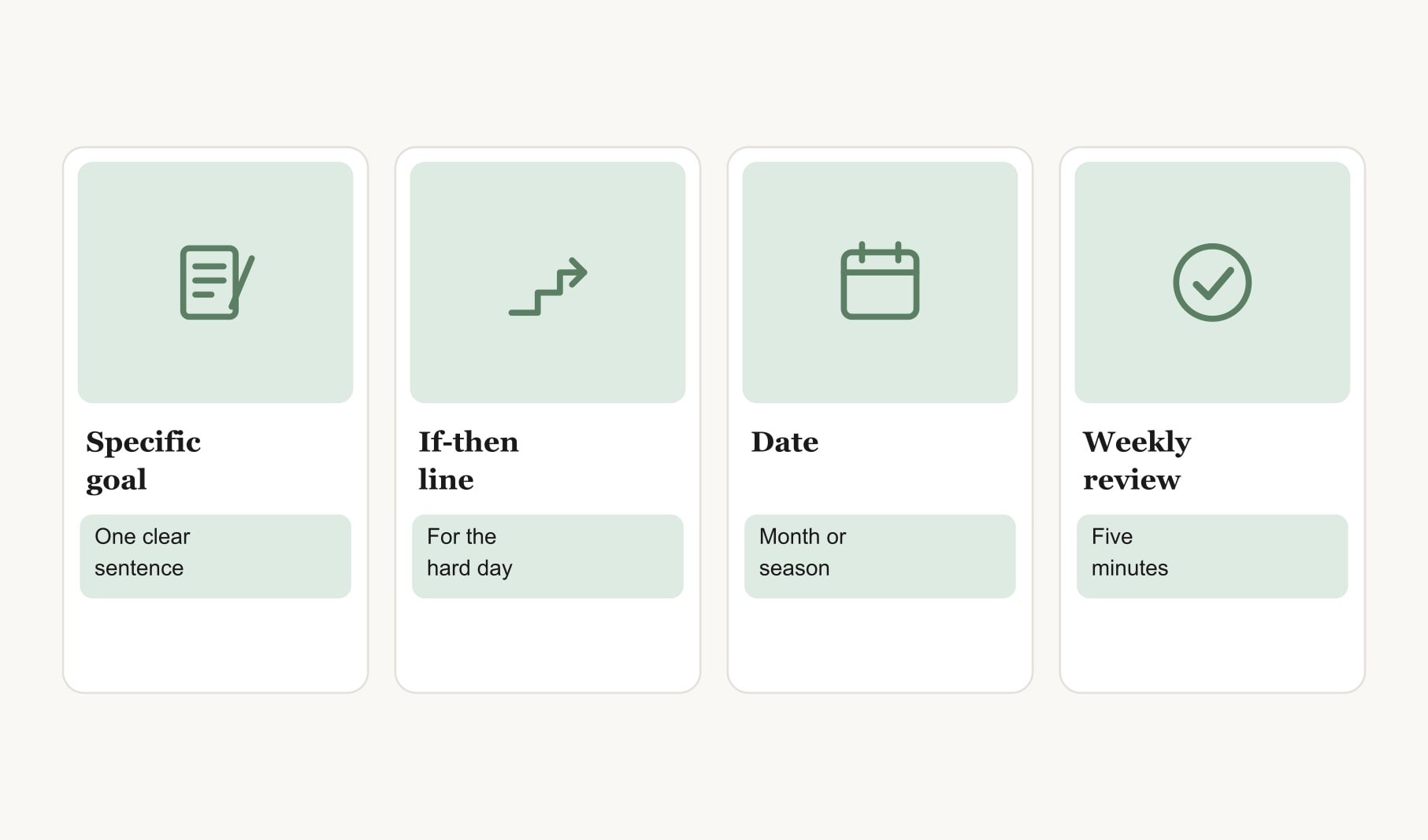
It keeps the parts that hold up and adds them to every vision: one specific goal written as a sentence, a date, an if-then line for the moment you are most likely to stall and a five minute weekly review. A SMART goals vision board builds this structure in from the start. If you want a fuller walk through the if-then idea, see my guide to if-then planning on a vision board.
Then measure what you can measure: actions. A habit tracker for your vision board lets you count the small steps each week, which gives you honest data about your own board instead of a feeling.
What would a fair test of vision boards look like?
It is worth picturing, because it shows what the current evidence is missing. You would take a large group of people with similar goals and split them at random. One half would make a vision board with dates and first steps. The other half would write the same goals, dates and steps as a plain list. Both groups would review weekly, and after a few months you would count actions taken and goals reached. Only a design like that could tell you whether the pictures add something beyond the plan. Until such studies exist, anyone who says boards are scientifically proven is going further than the evidence allows.
What can you take from this today?
Quite a lot, even with the gaps. You know which habits have the best support, so you can make sure your board carries them. You know which claims to be wary of, so you can enjoy the practice without expecting it to do your work. And you know how to measure your own results, which is the evidence that matters most to you.
So, do vision boards really work?
Here is my honest verdict. A vision board is a sensible way to carry well-supported habits into daily life, and many people find it helps them focus and follow through. Direct evidence for boards themselves is thin, and claims about images working on their own do not stand up. Build yours on the ingredients, judge it by what you do, and you will be on firm ground whatever you believe about how goals come to you.
Keep reading
Do vision boards really work: your questions
There is little direct research on vision boards themselves. The strong evidence is for their ingredients, such as specific goals, if-then plans and regular review. A vision board built around those ingredients is likely to help, but that is a reasonable inference rather than direct proof.
Claims that a vision board programs the subconscious are shaky. Some studies on goal priming, where brief cues were said to steer behaviour without awareness, failed when other labs repeated them. The firmer claim is simpler: a visible plan helps you remember to act on your goals.
Research gives no good reason to think a vision board changes outcomes without action. It also cannot say whether a board will work for you personally, because studies describe group averages. Pictures alone are not shown to deliver results, so pair every image with a step.
Ask whether the claim is about vision boards or about an ingredient like goal setting, whether anyone compared users with non-users, and whether it describes behaviour you can check. A claim that a board helped someone take more action is far easier to trust than one about outcomes.
A research informed vision board gives every vision a specific written goal, a date, an if-then plan for the moment you are most likely to stall and a short weekly review. These are the ingredients with the best support, carried into a format you see daily.
A fair test would randomly split people into a group making a vision board and a group writing the same goals, dates and steps as a list, then compare actions over months. Studies of that kind are what the evidence needs. Until they exist, claims that boards are proven go too far.
Some people find vision boards unhelpful because their boards hold only pictures, with no goals, dates or steps, so nothing prompts action. Others expect images alone to change outcomes. A board built on specific goals and regular review tends to give a fairer result.
Keep your vision board alive
A board built in your browser resets when you close the tab. Vision Boardly saves your boards, reminds you as each vision date arrives, and tracks the habits and moods moving you toward them.
Get Vision Boardly Free